2 Films | Monday, October 24th
For October 24th’s Spotlight on Classic Horror, TCM presents two films released in the late 1970s that feature the type of antagonists that don’t necessarily fit the mold of your typical horror villain.
Many films portray this type: someone on the fringe of society, who may be reclusive, eccentric, or very quiet and unassuming. There’s something about them that just doesn’t seem right. You simply cannot put your finger on it, but you are very wary of them. They may not portray themselves as menacing, but your gut keeps telling you otherwise. If these Creepy Loners don’t get under your skin, they will at the very least make it crawl.
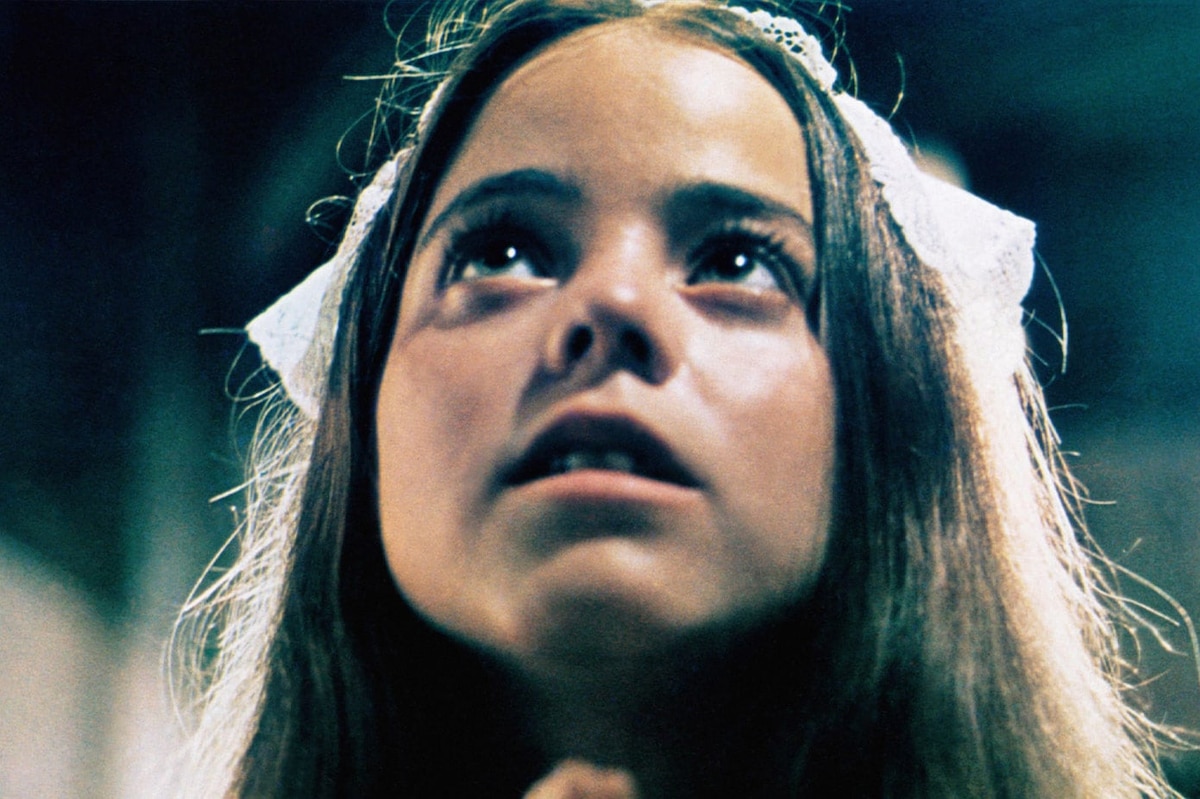
Directed and co-written by Alfred Sole, and starring Linda Miller, Paula Sheppard, Niles McMaster, Rudolph Willrich, Michael Hardstark, Mildred Clinton and a young Brooke Shields (in her film debut), the story of Alice, Sweet Alice (1976) begins with the preparation for a young girl’s Holy Communion.
Set in 1961 New Jersey, pre-teen Alice Spages (Sheppard) lives with her divorced mother Catherine (Miller) and younger sister Karen (Shields). As the bubbly, happy Karen is preparing for her special day, she receives a gift of a gold cross from the parish priest (Willrich). As Karen is (understandably) getting plenty of attention, Alice is more subdued and fades a bit into the background. When she plays a prank on the priest’s live-in housekeeper (Clinton) with a frightening plastic mask she gets some notice, albeit via chastising from her mother.
Alice is an odd child. She doesn’t seem to have any friends and spends much of her time alone. When not picking on her younger sister, she retreats to her own personal sanctuary in the basement of the house where her family rents an apartment. In a very odd ritual, she lights a candle among a collection of plastic masks and a doll that she stole from Karen. This sibling rivalry and rather disturbing behavior comes to a head on the day of Karen’s communion, when the girl is brutally murdered by someone wearing a plastic mask and yellow raincoat while waiting to enter the church for the ceremony. All eyes are on Alice as the possible perpetrator of such a brutal act, as well as a few more during the course of the film.
To give us a break from the girl with odd and potentially dangerous hobbies, the reclusive downstairs neighbor and landlord Alphonso (Alphonso DeNoble) is the one that you need to keep an eye on. In fact, his very introduction induces a feeling of disgust, even more so if you were to strictly go by one rather nauseating meal choice. He is a slovenly man with a penchant for show tunes that babies a coterie of cats, and while he doesn’t appear in many scenes, each one he is in induces that feeling of ickiness. Along with that strange demeanor and off-putting dinner selection, he does not leave his house, nor clean it (Alice nastily but pointedly comments that the home is malodorous from the felines relieving themselves). He doesn’t seem to keep up with his own personal hygiene either, as he is clad in the same soiled undershirt and pants throughout the film and has brown, rotting teeth. The delivery of his dialogue, regardless of the topic, always comes out as lecherous and grotesque, which gets increasingly uncomfortable once his true intentions toward Alice are revealed.
While much of the plot device and imagery portrays the various characters’ adherence to Roman Catholicism, their perceived piety, an absentee father, and horrible acts involving a pre-teen girl, one could make a small comparison to a film that was released a few years prior, in 1973: The Exorcist. In fact, there is an additional connection to it as Linda Miller is the former wife of Jason Miller, who starred as Father Damien Karras.
According to sources, the film was originally titled Communion and premiered at the Chicago Film Festival in 1976. After its acquisition by another studio, the title was changed to Alice, Sweet Alice and released again in 1977. The film was re-titled and re-released once more in 1981 as Holy Terror, ostensibly to capitalize on Shields’ growing fame from her roles in Pretty Baby (1978) and The Blue Lagoon (1980).
As with Alice, Rynn Jacobs in The Little Girl Who Lives Down the Lane (1977), leads a fairly solitary life. Written by Laird Koenig and based on his novel of the same name, Rynn (Jodie Foster) has moved with her playwright father from England to the quaint community of Wells, Maine. Throughout most of the film, Rynn is shown as quite self-sufficient, lacks any real parental supervision, and doesn’t attend school. As it seems that her father is nowhere to be found, Rynn always stresses that he’s working in his study or off to meet his publishers, some of the residents take it upon themselves to pry into the lives of father and daughter.
As with the previously mentioned film, Rynn must contend with a creepy loner, Frank Hallet (Martin Sheen). In the first scene, set on Halloween night and coincidentally Rynn’s 13th birthday, Frank barges into the house. As he claims to know her father (my own gut instinct says that he doesn’t) and rambles on and on, he begins making increasingly inappropriate comments on Rynn’s appearance and asks very intrusive questions. Unlike Alphonso in Alice, Frank Hallet doesn’t outwardly look the part of a creep. He’s quite clean-cut and handsome in appearance, but his overtly inappropriate actions and demeanor denote his apparent attraction to very young girls.
When Cora Hallet (Alexis Smith), the town realtor who has leased the home to the Jacobses, comes calling, Rynn grows increasingly frustrated not only because the woman badgers her as to the whereabouts of her father, but dismisses her statement that her son is making unwelcome advances on her. Cora routinely oversteps her bounds and has heated interactions with Rynn in her demands to access parts of the house. The girl continues to be elusive and constantly changes the subject, but Cora will not let up and continues to the point of interrogation. When she forces her way into the basement, despite Rynn’s fervent attempts to keep her out, Cora suffers an awful fate.
After her newfound love interest Mario (Scott Jacoby) helps her in this most precarious situation, he learns all of Rynn’s secrets, which have threatened her autonomy and independence. This brief period of bliss is interrupted because Frank is back and ready to punish her. This time, he pulls no punches: he knows what she has done and for his silence, he blackmails her into being his sexual slave. Rynn once again takes matters into her own hands and protects herself against someone actively trying to harm her with more deadly consequences.
While Rynn’s actions are said to be much darker and sinister in the novel than in the movie, she puts on an act of toughness to not only intimidate, but to mask her very real fear of both exposure for what she has done and attack by this repulsive and morally bankrupt man. Foster, previously nominated for a Best Supporting Actress Academy Award as teenaged prostitute Iris Steensma in 1976’s Taxi Driver, earned a Saturn Award for Best Actress for this role. The Little Girl Who Lives Down the Line would also earn a Saturn Award that year for Best Horror Film.
The two young girls in these movies have quite a bit in common and could also be construed as loners themselves. Each girl on the cusp of her teenage years has to contend with physical and mental changes, parents that either don’t understand them or who aren’t physically or emotionally present. They both become the target of men who are utterly abhorrent and predatory, and both men receive a well-deserved comeuppance.
While the outwardly creepy loners were dispatched, in the end, the utter destruction and chaos both surrounding and within the lives of the girls in these two movies spiral beyond control. The end result is that whether in thought, deed or circumstance, both Alice and Rynn wind up alone again and may continue to descend into darkness.
