In partnership with The Film Foundation, iconic film director and classic movie lover Martin Scorsese's exclusive monthly contribution to the TCM newsletter Now Playing in September 2022.
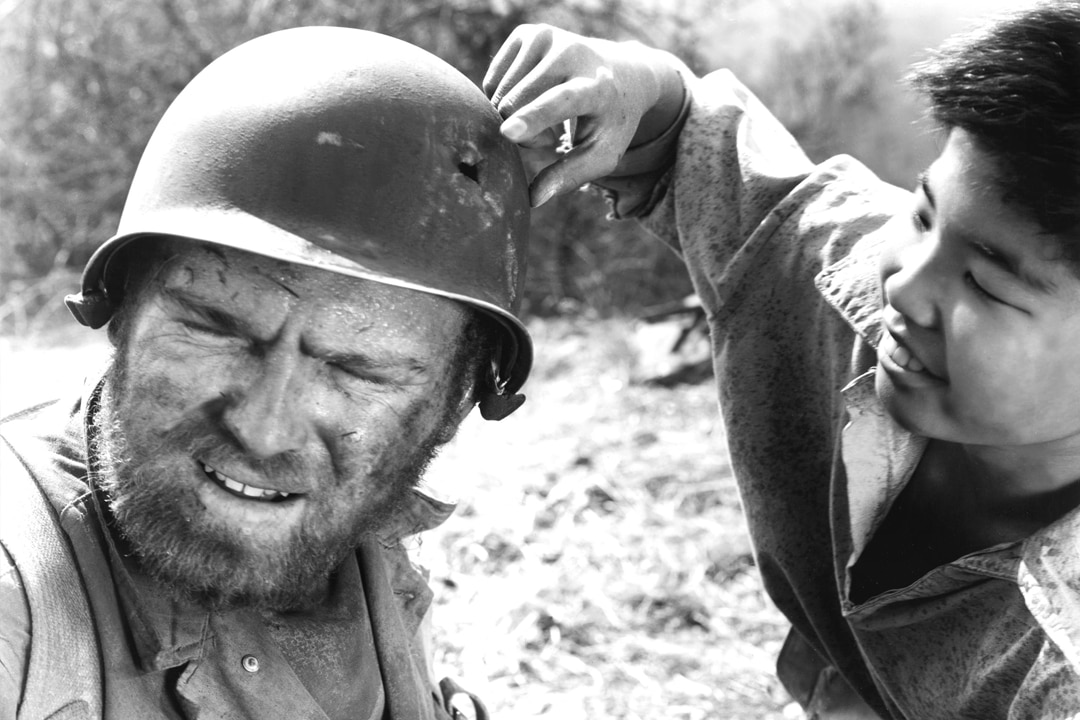
On September 3rd, Sam Fuller’s The Steel Helmet will be shown as an overnight feature. It was the very first film with a Korean War setting, and it pulls no punches. There were many movies made during this period that were designed as demonstrations of anti-Communism and unqualified patriotism from the studios. But for Fuller, the North Korean and Chinese regimes were hateful not for their ideology but their treachery—the same goes the American CP in Pickup on South Street. You might not agree with him, but he meant it. And among the American fighting forces in this picture and in the ones that followed, there is no love lost between individual soldiers. In The Steel Helmet, there is kneejerk racism and general distrust among the members of the American unit forced to take refuge in a Buddhist shrine, and it’s the need to survive that pulls them all together.
Fuller had been through WWII, he’d seen a lot of fighting in his famous infantry unit “The Big Red ‘One,’” and he refused to sugar coat anything. The Breen Office raised red flags over multiple issues in the script, and the U.S. Army strongly objected to the moment where Sergeant Zack, played by Gene Evans, shoots a North Korean prisoner of war dead. Fuller’s response was that he had seen the execution of enemy POWs happen many times when he was a soldier, and he allegedly asked his former commander to confirm as much with the Pentagon.
The Steel Helmet has a bracing frankness that set it apart from the majority of war pictures coming out of Hollywood. Of course, that’s partly due to the fact that it was made independently, by producer Robert Lippert, on a very low budget and an unbelievably tight schedule of ten shooting days. A $100,000 war picture without any stars could slip elements and values under the radar with greater ease than a studio film (the irony is that The Steel Helmet was such a massive hit that Fuller was offered a long-term contract by Darryl Zanuck at Fox, which is where he made Fixed Bayonets!, just as uncompromising).
But what really set The Steel Helmet apart was the particular combination of Fuller’s temperament and his talent—maybe they’re one and the same. Fuller came at the tail end of the first wave of writer-directors that started with Sturges, Huston and Wilder, and on the face of it he was less serious than any of them, a pulp artist. But he thought and expressed himself in purely cinematic terms, and in his greatest pictures—The Steel Helmet is one of them—every camera movement and every cut lands with maximum graphic and emotional impact. As Fuller, playing himself, says to Jean-Paul Belmondo in Jean-Luc Godard’s Pierrot le fou, “A film is like a battleground—it’s love, hate, action, violence, death…in one word, emotion.” Fuller was an inspiration to many filmmakers of my generation, myself included, and aspiring filmmakers should check any preconceptions they might have at the door and find their way to his pictures.
