This article was originally written about programming for the TCM Now Playing newsletter in June 2022.
Before the 1950s, there were no teenagers in the movies, at least not in any way we understand the teenage years today. There were adults and children, and that awkward age in between was largely seen as, well, that awkward period in between. You had kids on the cusp, troubled young adults and juvenile delinquents, but the teenager, with his / her hormonal surges and anxieties and identity crises, was pretty much ignored.
Rebel Without a Cause (1955) gave audiences the first American teenagers and James Dean became the screen embodiment of the misunderstood high school kid. It's in his wound-up performance, his stumbling, mumbling delivery, his shrugging stance and the guarded presence that gives way to compassion and protectiveness as he connects with Natalie Wood's "bad girl" next door Judy and Sal Mineo's lonely, vulnerable Plato.
And it's his iconic outfit, the casual cool of blue jeans, white T-shirt, and that cherry red bomber-style windbreaker. The Wild One (1953) had immortalized the black leather jacket over T-shirt and jeans as the uniform of the delinquent but the motorcycle gangs lead by Marlon Brando and Lee Marvin were anything but juvenile. Dean might have ended up with the same outfit had the film gone into production in black and white as originally planned. After viewing the footage of the first couple of days of shooting, Warner Bros. made the decision to upgrade the production to color and director Nicholas Ray, so attuned to the power of color to draw the eye and create visual drama within the frame, swapped the black leather jacket for a red windbreaker.
Where exactly the jacket came from is a matter of some dispute. Ray himself claimed credit, insisting that he took it off the back of the production's First Aid worker, dipped it in black paint to remove the sheen, and handed it to Dean. Frank Mazzola, a young actor who played a gang member in the film, says the actors picked out the windbreaker on a cast shopping trip to a Hollywood clothing store called Mattson's. And Moss Mabry, the film's costume designer, says he fashioned the jacket specifically for Dean from a bolt of red nylon.
Whatever the source, the jacket became iconic. In the words of Lawrence Frascella and Al Weisel, authors of "Live Fast, Die Young: The Wild Ride of Making Rebel Without a Cause," that vivid red pops out of the film with a whole set of associations: "the anger of adolescence, the audacity of rebellion, the threat of blood and violence, as well as a definite sexual bravado." It also connects Dean's Jim Stark to Wood's Judy, who makes her first appearance in a vivid red coat.
While the jacket draws the eye and set Dean off from the gang members (all in their familiar black leather), the simple but expressive ensemble completes the character. Ray and screenwriter Stewart Stern spent months researching troubled teens and juvenile delinquency to develop the screenplay and they were determined to capture the reality of contemporary high school kids as closely as possible. The costume department soiled and laundered over 400 pairs of jeans to create the well-worn look that teenagers preferred, and they were matched with hundreds of T-shirts. When the production switched from black and white to color, those jeans were then re-dyed to register more vividly on screen. That attention to detail worked. America's teenagers really saw themselves on screen for the first and they responded by making the film a sensation.
James Dean died weeks before the film was released, making the film as much a memorial for the actor as a triumph. For many it froze that image of Dean as the restless Jim Stark, in blue jeans and a red jacket over a white T-shirt, hair combed back in a gentle pompadour. Within weeks of the film's release, that red jacket had been adopted by teenaged boys across the country. Decades later, posters of Dean in his Rebel red jacket could be seen in dorm rooms, diners, record shops, poster galleries, clothing stores and almost anywhere that wanted to be associated with the cool of Dean's rebellious teenager. For many, it remains the definitive image of James Dean.
Just a few years later, in a very different youth culture across the Atlantic, Jean-Paul Belmondo played a genuine rebel without a cause in Jean-Luc Godard's Breathless (1960). Michel Poiccard, however, is no teenager. This twentysomething in a state of arrested adolescence is a punk and a petty thief, a criminal of opportunity who lives for the moment and runs on impulse.
The debut film by Godard, a film critic turned filmmaker, was a cinematic blast across the bow of the French filmmaking and international cinema. Dedicated to American Poverty Row studio Monogram Pictures, Breathless (originally released in France under the name À bout de souffle) is Godard’s tribute to B-movies and American crime cinema. Belmondo's anti-hero Michel is a lanky rogue who is as reckless as he is charming. He impulsively kills a cop in a car theft getaway and stops off in Paris to collect his share from a score and woo his American girlfriend Patricia (Jean Seberg) to join his flight from the cops. It's a crime movie taken apart and rebuilt from the ground up and Godard's free spirited street shooting, jagged editing, audacious jump-cuts and lighthearted comic asides created a revolutionary sense of self-awareness. It's a movie as much about the fact that it’s a movie as anything going on in the story and the guerilla approach gives the film a kind of energy new to the cinema.
A former boxer who wears his past on the mashed-up nose on his face, Belmondo was finding success on the stage and had made a couple of films, including the comic short Charlotte et son Jules (1958) for Godard. The director promised to cast Belmondo in his first feature and kept his word, developing the part of Michel with Belmondo in mind.
For the role of Patricia, Godard fought to sign Jean Seberg, star of Otto Preminger's Saint Joan (1957) and Bonjour Tristesse (1958), opposite the still-largely unknown Belmondo. The young actress had endured abusive treatment under Preminger and savage reviews from film critics (a glowing note from François Truffaut was a notable exception) and left the States for Paris. Though reluctant to work with the first time filmmaker, she found the role more interesting than anything else she had been offered and signed on.
In his efforts to upend the conventions of cinema storytelling, Godard stripped his production crew down to the essential. As a result, there is no costume designer credited to the film. It's likely that both Belmondo and Seberg provided their own wardrobes, which makes their respective contributions to the film's iconic power all the more remarkable.
Michel is enamored with the glamor of American tough guy movie stars, notably Humphrey Bogart, who he emulates in both practiced mannerisms and fashion choices. (To make the point explicit, Godard has Belmondo stop in front of posters of American films, including 1956’s The Harder They Fall, Bogart's last feature, and a display of movie stills featuring Bogart.) This was just after Bogart's death and he had become the epitome of Hollywood cool. Michel appropriates the costume on the cheap, with a succession of fedoras, ill-fitting jackets, and too-short loosely-knotted ties over a striped shirt. A cigarette lazily dangling from his lips completes the look, and toward the end of the film he adds a pair of sunglasses. Like the film itself, it's a casual, endearingly sloppy take on American crime movie fashion (Vanity Fair writer Kate Scheyer described it as "beatnik-bourgeois") and Belmondo sells it with his loose, swaggering performance and rakish insouciance.
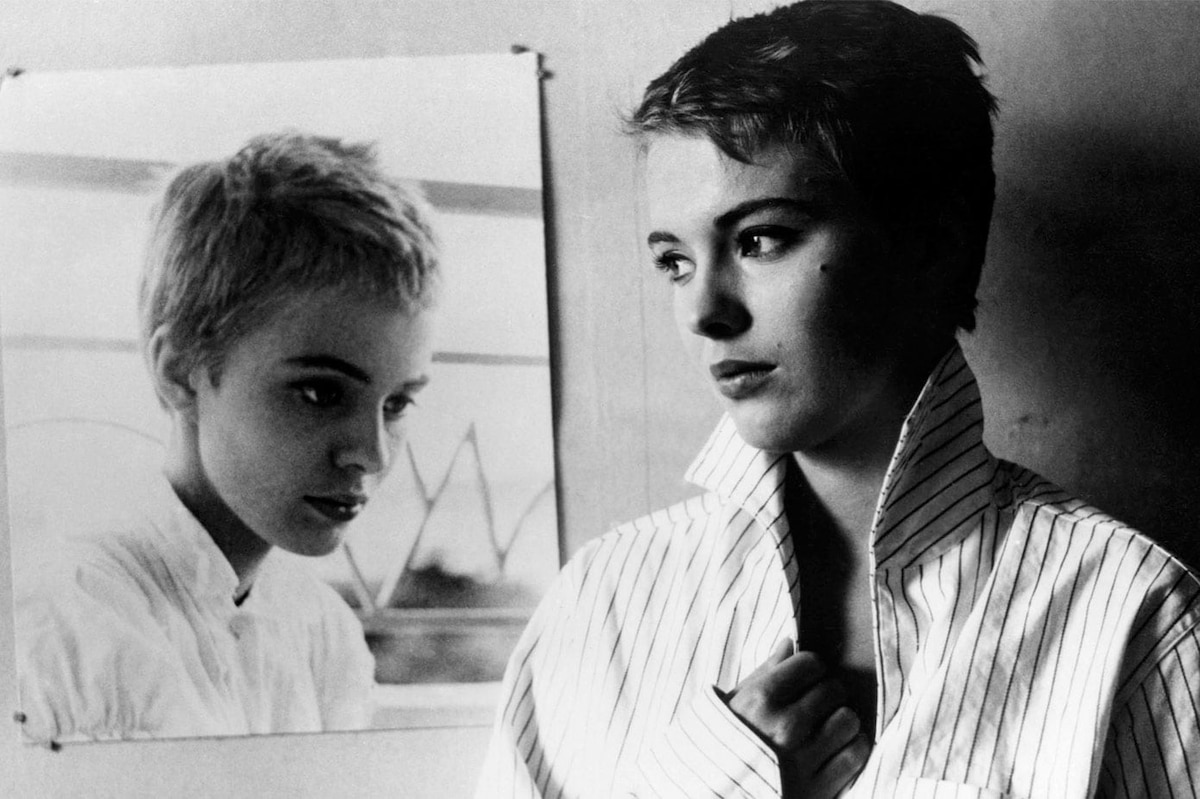
Seberg's Patricia enters the film hawking American newspapers along the Champs-Élysées clad in a fitted T-shirt (branded with her paper, the New York Herald Tribune) and skinny black pants. While Michel stays with the same essential look, as if it’s the uniform of the aspiring gangster, Patricia swaps out her work clothes for pleated skirts, summer dresses, sailor stripes and ballet flats. And she keeps the distinctive pixie cut from Bonjour Tristesse, where it had been used to give her a sense of worldly sophistication and continental style. In Breathless, it gives her the air of a liberated young woman making her way in the world, the perfect complement to her easy, naturalistic performance. The totality is an iconic look: at once a tomboy-ish independent young woman and an innocent American in Paris with a flair of French chic. The fresh, natural simplicity and understated style resonated with audiences on both sides of the pond.
Breathless made a star of Belmondo, who became one of France's most popular leading men, and it recharged Seberg's stalled career. Together, they ushered in a new style that inspired a generation to emulate, the retro-Hollywood tough guy cool on a thrift store budget of Belmondo's Michel and the sleek department store simplicity of Seberg's Patricia. More than sixty years later, those simple fashions are just as inspiring.
