This article was originally written about programming for the TCM Now Playing newsletter in June 2022.
Costumes and decor add so much to the visual spectacle of film. How a costume designer dresses the actors and how a production designer styles the interiors can alter a story’s tone and mood. These designs can range from understated to provocative and they ultimately aid the filmmakers in creating a world that an audience can get lost in. While fashion and interior design are two separate art forms, they both use colors, textures, shapes, lines, layers and many other aesthetic elements to create a particular look. On set, these artists are key to translating a filmmakers’ vision into reality.
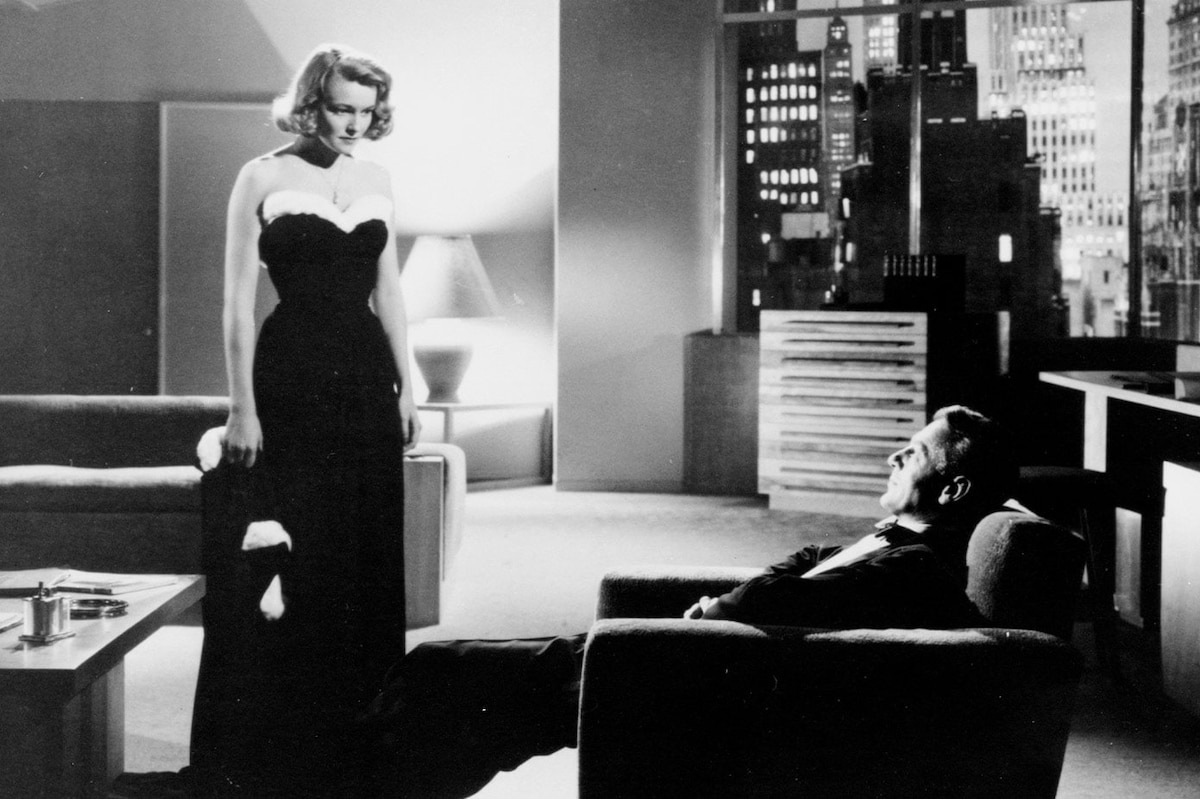
King Vidor’s The Fountainhead (1949), an adaptation of Ayn Rand’s best-selling novel of the same name, conveyed its message of individualism through its protagonist Howard Roark, played by Gary Cooper, with his modern and minimalist architectural designs. Rand modeled Roark after celebrated architect Frank Lloyd Wright. Warner Bros. wanted to hire Wright himself to create the building designs for the film, but his $250,000 retainer fee proved to be too costly for the studio. Instead, art director Edward Carrere was tasked with creating sketches and models in Roark’s vision. For interiors, Carrere and his team created workspaces that were simple and bare with clean lines and minimal decor. Large windows framed the city landscape behind them. The spaces were given a vertical look by adding only a few pieces of simple furniture and framed photographs that were positioned low on the wall. Both the architectural designs and interior decor favor function over fashion which is key to Rand’s vision for Roark.
Dominique Francon, played by Patricia Neal, is the daughter of an architect whose work tends to be more elaborate and indulgent—the opposite of Roark. When Dominique and Roark meet, she’s staying at her father’s home and her room is cluttered with ornate furniture and window drapes shut out the view of the quarry nearby. Dominique takes a metal fire poker to the marble base of her intricately designed fireplace to crack it in a way that Roark, who is working in her father’s quarry, will have to be called upon to fix.
Although she’s in this designed space that Roark refers to as “outrageous,” she leans more towards Roark’s vision of simplicity and function. This can be seen especially in Neal’s wardrobe designed by costumer Milo Anderson. The costumes are beautiful yet simple in design with one or two tones, no patterns or more than the occasional set of stripes. Neal’s outfits are more functional whether it’s a blouse, jodhpurs and gloves for horse-riding, a collared dress for work or a no-frills yet elegant gown for parties. Her wardrobe shifts when she marries newspaper magnate Gail Wynand (Raymond Massey) and we see more lace and fanciful trimmings. Milo Anderson, who was responsible for dressing created another iconic look for Patricia Neal in her sophomore film.
When The Fountainhead was released in 1949 it was panned by the critics. According to the AFI, Edward Carrere's sets were scorned by the architectural press. Interiors critic George Nelson, as quoted in a modern source reprint, called the sets the "silliest travesty of modern architecture that has yet hit the film," and "a total perversion of formal and structural elements.” Yet the visual style of the film went on to inspire artists, especially architects.
When cinematographer Robert Burks, A.S.C. was interviewed for the American Cinematographer magazine in 1949, he noted that Vidor, Carrere and himself agreed “the settings and camera approach should be kept as simple as possible, since simplicity and functionalism were fetishes with Howard Roark.” Carrere was inspired by Rand’s descriptions of structures created by Roark and used a “cantilever design for some of the buildings” which gave them a modern, futuristic look. He created over 300 architectural drawings as well as 36 interior sets and 34 exterior ones. The article goes on to say that “these settings are characterized by bold but simple lines, plus the use of structural materials of varying textures.”
Now let’s look at a film that is the opposite of The Fountainhead in both fashion and interior design. Directed by Stephen Frears, Dangerous Liaisons (1988) is a sumptuous period piece set in 1760s France. Based on the 18th century novel “Les Liaisons Dangereuses” by Pierre Choderlos de Laclos, the film adaptation boasts an all-star cast including Glenn Close, John Malkovich, Michelle Pfeiffer, Swoosie Kurtz, Keanu Reeves and Uma Thurman. The characters they play live in a time of decadence and indulgence and are dressed in a way to reflect this. Costume designer James Acheson and his team of costumers, jewelers, milliners, embroiders and decorators created costumes that were both period specific but also reflected the character’s wealth and social position. Opening sequences depict Valmont (John Malkovich) and the Marquise (Glenn Close) being dressed in an elaborate process that takes several servants to execute. This demonstrates their level of social dominance. The naïveté of Cécile (Uma Thurman) and Danceny (Keanu Reeves) is reflected in their youthful and frilly attire. Michelle Pfeiffer, who plays Tourvel, the target of the Valmont and the Marquise’s machinations, wears less fashionable ensembles in creams and pastels that are the opposite to the rich hues worn by others in her social circle.
According to the AFI, director Frears “was adamant that costumes and production design did not upstage the story or actors’ performances.” While the book was set in 1782, the filmmaking team decided to move back the film’s setting to the 1760s. This made the most sense when it came to costume design and hairstyles. The 1780s French style of dress was flamboyant with tall, powdered wigs pinned with fanciful hats and women wore much wider hooped skirts. This would have looked comical on screen while the 1760s fashion trend which featured more subdued hairstyles and a less pronounced silhouette wouldn’t distract the viewer from the story at hand.
Even so, Dangerous Liaisons costume and interior designs are a celebration of excess. This is a world of the wealthy elite who have everything they could possibly want and then some. So much so that they’re wallowing in their ennui. They’ve exhausted what they can extract from the physical realm and now invoke psychological warfare for their own amusement.
The attention to detail to the design in the film showcases the time and labor that went into creating the aesthetics for this impractical lifestyle. Acheson and his team had just three weeks to research historical fashions and less than seven weeks to create over 100 costumes. Because of all of the close-up shots of costumes in the film, silk, cotton and other quality fabrics were used. This was a challenge with the production’s limited budget but necessary because cheaper fabrics would not have been as aesthetically pleasing.
Scenes were filmed in historic French chateaus that were decorated in the Georgian style (1714-1830). Production designer Stuart Craig said “only the existing rooms that conformed to that concept were considered. When we ran short a few rooms or a corridor, we had to build it.” Craig and art directors Gavin Bocquet and Gérard Viard worked with a team of prop masters, painters, carpenters and foremen to recreate the world of 1760s France while also utilizing existing spaces. The Georgian style of interior decor was inspired by ancient Rome and included classic columns, figurines of gods and goddesses and fantastical creatures and incorporated blues, greens and pinks. In the film, elaborate wallpapers, framed oil paintings, hand crafted furniture and heavy drapes serve as a backdrop.
Architectural Digest called Dangerous Liaisons “a mega-luxe version of the classic tale of lust and lechery… [the film] bursts out of every frame like an overstuffed bodice. Bright, shiny, gilded, powdered, and corseted, its essential viewing as a reference for true decadence and going too far, morally and aesthetically.” All that attention to detail paid off. Dangerous Liaisons was nominated for seven Academy Awards. Stuart Craig and Gérard James won for Best Art Direction-Set Direction and James Acheson won for Best Costume Design.
