“Follow the Thread,” TCM’s expansive spotlight on the importance of fashion in film, continues on HBO Max with one of the most fashion-forward, important and influential genres—the dystopian film. TCM’s Alicia Malone hosts this excursion featuring six films: Stanley Kubrick’s 1971 A Clockwork Orange, Michael Anderson’s 1976 Logan’s Run, George Miller’s 1981 The Road Warrior, Ridley Scott’s 2007 “Final Cut” of his 1982 classic Blade Runner, Paul Verhoeven’s 1997 Starship Troopers and the Wachowskis’ 1999 The Matrix.
A Clockwork Orange was based on Anthony Burgess’ novel set in a near-future England and was quite controversial. It was rated X in the U.S. and Kubrick pulled it from circulation in the U.K. in 1973 because he received death threats amongst copycat crimes. Malcolm McDowell electrified as Alex DeLarge, an anti-social thug with an obsession for Beethoven and brutality who leads a group of delinquents called the “Droogs” on an evening of “ultra-violence” after they get drunk on the drug-filled “milk-plus.”
The film was nominated for four Oscars with Kubrick earning three for picture, director and adapted screenplay. Sadly, Milena Canonero wasn’t nominated for her indelible costume design.
A Clockwork Orange wouldn’t have been as terrifying without Alex and the Droogs’ kinky cricket attire of white button-down shirts and pants and replete with a bowler hat, cane and jockstraps worn on the outside of their pants. A false eyelash on one eye added a bit more non-binary malevolence to the Droogs. Their outfits were a middle finger to the rigid British class system which the Droogs wanted to destroy.
These costume designs have inspired such designers as Jean Paul Gaultier and such rock stars as David Bowie, who incorporated elements of Alex’s look into his Ziggy Stardust persona beginning in 1972, as well as Madonna.
The film marked the costume designer debut of Canonero, who would win the first of her four Oscars for Kubrick’s 1975 masterwork Barry Lyndon. The simplicity of the design “helped make the outfit iconic and could help explain its enduring presence on fashion mood-boards and catwalks,” wrote Elena Lazic in a 2019 article for BFI.
“But while other similarly popular films have seized the imagination of designers, most of them have turned out to be passing fads or occasional homages. With ‘A Clockwork Orange’s’ lasting influence, something else is at work: to quote Coco Chanel ‘Fashion fades, only style remains the same.’’
She added: “The items Alex uses to symbolically attack the upper class also help in physically attacking them.”
Canonero explained to designer Deborah Nadoolman Landis in her 2005 book “Costume Design” that Kubrick had her travel through London with her camera to capture the denizens of the city. “I went out taking hundreds of photos all over London. I was inspired, for the film costumes, by the Skinheads on the streets of London. I designed all the costumes to create a surreal imagery.”
According to McDowell, though, the cricket gear and jockstrap came from his car. In a 2011 GQ interview, McDowell recalled telling Kubrick: “’I’ve got cricket gear in the car.’ ‘Let’s see it,’ he said. ‘Put it on.’ And then he goes. ‘What’s that?’ ’Why that’s my cricket protector.’ ‘Well, wear it on the outside,’ he tells me. So, the whites were literally my cricket gear. He had been thinking about a codpiece anyway, because he liked the sort of Medieval feel.”
While A Clockwork Orange designs seem timeless at 51, the costume designs of the box office smash Logan’s Run have dated badly, stuck in a 1970s time capsule that looks more disco inferno than sci-fi. It’s more popular these days as a Halloween costume and cosplay favorite.
Set in 2274 in a sealed-off city, Logan’s Run finds its residents prohibited from living past the age of 30. But they have a wild and crazy time before they hit their third decade. Michael York plays a police agent, one of the Sandmen who track and capture those who try to escape their fate. Jenny Agutter is a member of a secret group who helps the runners.
Veteran costume designer Bill Thomas, who was nominated for ten Oscars, winning for 1960’s Spartacus, dressed the Sandmen in form-fitting black outfits with a gray band across the chest. And Thomas attired the under-30 residents in flowing tunics and bright colors which also showed a lot of skin.
Thomas’s approach to the design was to “stick to the fabrics and aesthetics of the time, which is why the film today seems hopelessly outdated,” said blogger Jack Mackenzie in 2018, adding that the Sandmen ensemble “made quite an impact, despite their simplicity.”
Tunics were made from Lycra and spandex. “Satin was also used along with cotton and sheer materials. These materials were considered fashion forward. Jewelry and belts were ‘finishing off’ of the costumes. The bigger and more elaborate the better.”
But Thomas’s costume design works perfectly for the movie-the stark Sandmen ensemble reflects the authoritarian rule of the city while the residents’ colorful, freely flowing tunics emulate the hedonistic, pleasure-filled life the under-30s enjoy.
Thomas was also the costume designer for the short-lived 1977 CBS series version of Logan’s Run.
Several years after Logan’s Run, two of the most indelible dystopian films were released The Road Warrior-the Australian production known as Mad Max 2-and Blade Runner.
Norma Moriceau was the costume designer on The Road Warrior, the sequel to Mad Max, starring Mel Gibson, which was treated as an exploitation flick when released in the U.S. in 1979. This time around, Gibson’s loaner Max roams the post-apocalyptic wasteland with his loyal dog looking for gas and oil only to end up helping a group of settlers threatened by a violent, post-punk motorcycle gang.
The Australian-born Moriceau was a model before moving to London where she worked as a photographer, stylist and editor. She became friends with iconic fashion designer Vivienne Westwood and her partner Malcolm McLaren and collaborated with the duo on film shoots. And her involvement in the London punk and fashion scene inspired her epochal costumes for The Road Warrior.
According to her article for the National Film and Sound Archive of Australia (NFSA), Tara Marynowsky noted that Moriceau built upon the “punk aesthetic development” by costume designer Clare Griffin, makeup-artist Vivien Mepham and Miller for the original Mad Max.”
With its shoestring budget, the leather looks of the original Mad Max were often just made from plastic with distinctive hair color and small tattoos used to identify one gang from another.
Moriceau, who also designed 1985’s Mad Max Beyond Thunderdome, extended the punk aesthetic and added her own bent, satirical spin. She combined fetish and bondage gear, as well as “motorcycle wear and sporting equipment detailed looks for every post-apocalyptic character including extras. She helped the actors fill in their narrative backstories in a fashion that has inspired cosplayers ever since.”
Especially Max’s outfit-his leather jacket was embellished with two football shoulder pads; the tailgate of a car was turned into his hinged leg brace and a 1930s cricket pad was transformed into his knee pad.
During a 2019 tribute to the late Moriceau at the Australian Production Designers Guild Award, she was described as a “riddle wrapped up in a mystery, inside an enigma with crocodile teeth and leopard skin and broken-down jackets.”
A month after the U.S. release of The Road Warrior, audiences were immersed into an even darker abyss with Blade Runner, based on Philip K. Dick’s “Do Android’s Dream of Electric Sheep?” This stylish, claustrophobic and bleak thriller set in an overcrowded over-neoned and rain soaked 2019 Los Angeles stars Harrison Ford playing a cynical, world-weary former police detective Rick Deckard. He’s enlisted back into hunting down replicants (bioengineered humanoids) who escaped from their outer space colony and are in L.A.in search of their creator.
Designers Michael Kaplan and Charles Knode tipped their hats to 1940s film noir with Ford’s costume. Just as Bogey, Dana Andrews, Robert Ryan and other noir icons, Ford wore a brown trench coat over nondescript suit. Ford supposedly nixed wearing a fedora, one of the hallmarks of the noir anti-hero, because he had just worn a hat in 1981’s Raiders of the Lost Ark.
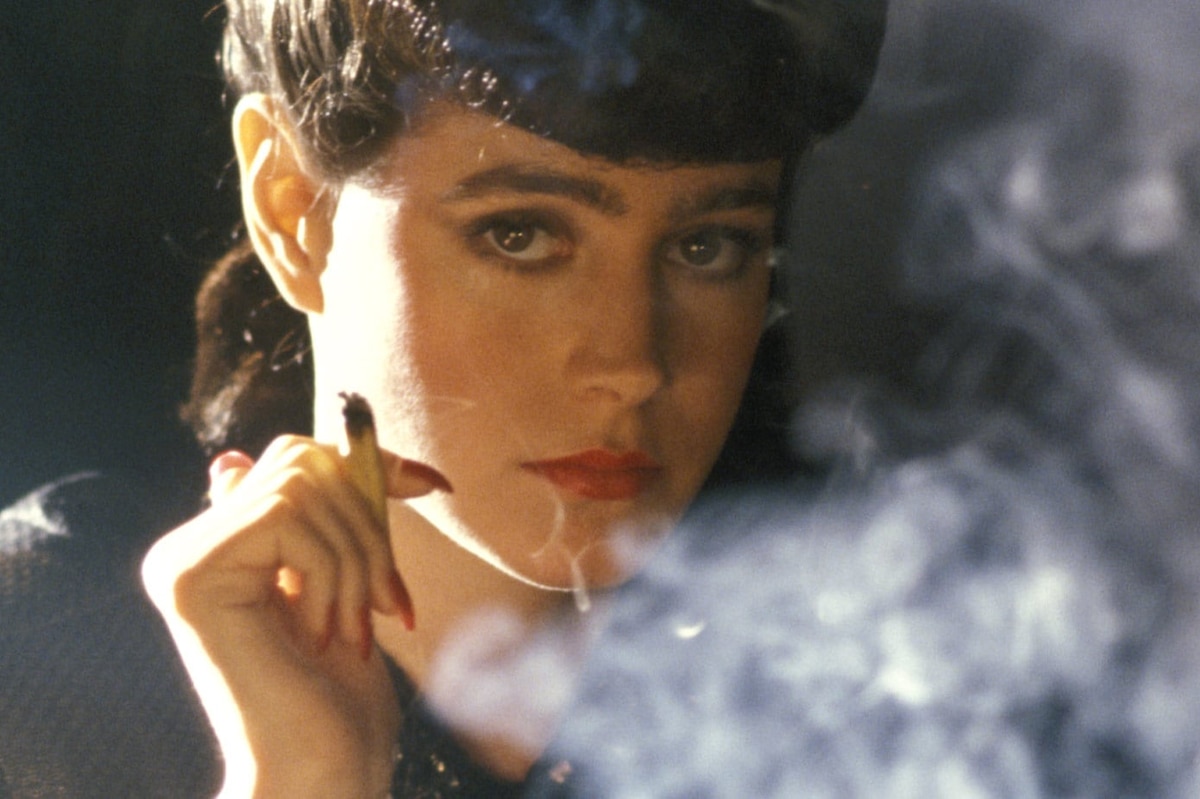
For the glamorous Rachael (Sean Young), who plays the Tyrell Corporation’s assistant who happens to be an experimental replicant, “our chief inspiration were the tailored suits that Adrian designed in the late 1930s and early 1940s,” said Kaplan in a 2012 interview with AnOther.
“I liked the idea of combining different shades of suiting fabrics and to create patterns-something Adrian did. In this case I used amazing vintage suiting woolens in shades of grey and beige with metallic threads that I was lucky enough to find, which created a subtle luminous quality. I wanted to create a futuristic heroine who was believable in the future, but with her feet firmly planted in film noir past.”
The film noir vibe continues in The Matrix, which caused a sensation winning four Oscars and spawning three sequels, with the latest, The Matrix Resurrections being released in 2021.
In the Wachowski’s dystopic universe, society is unknowingly trapped in a simulated reality created by intelligent machines using their bodies as an energy source. Those who escaped the Matrix include Neo (Keanu Reeves), Morpheus (Laurence Fishburne) and Trinity (Carrie-Anne Moss). They are all part of rebellion against the machines.
Australian Kym Barrett had only done two films when she was tasked with creating the two worlds of The Matrix.
A 2019 Fashionista article by Fawnia Soo Hoo noted that the film had been “continuously influencing designers since John Galliano sent his PVC, micro-glasses and red dress heavy haute couture collection down the runaways for Christian Dior Fall 1999 just months after the film hit theaters.”
Barrett wanted to support the Wachowskis’ vision through her costume design.
“When we made The Matrix we were aspiring to what the world could be, which is happening now,” Barrett noted. Fashion, though, was the last thing on her mind in 1998 when she began working on the film. “All I thought was, how can I make these worlds real and be distinctive. It was about how to create a language that the audience could clue them into what we were doing subconsciously, so when the story began to reveal itself, it was already embedded in some way in the consciousness.”
The real world, she added, was one of recycling. “When somebody dies, their uniform gets washed and goes back into the closet of military clothes. Anything they have, they make out of recycled things that they find. When they go into the Matrix, they create their persona, which is how they seem themselves. So that was a chance to have a little bit of fun.”
According to Barrett, Morpheus, Trinity and Neo are the film’s superheroes. “They can move in an almost gravity-defying way. They can jump across buildings; they can almost fly. I wanted to find a modern version of something that could move like a cape, so that’s where the coats were born.”
