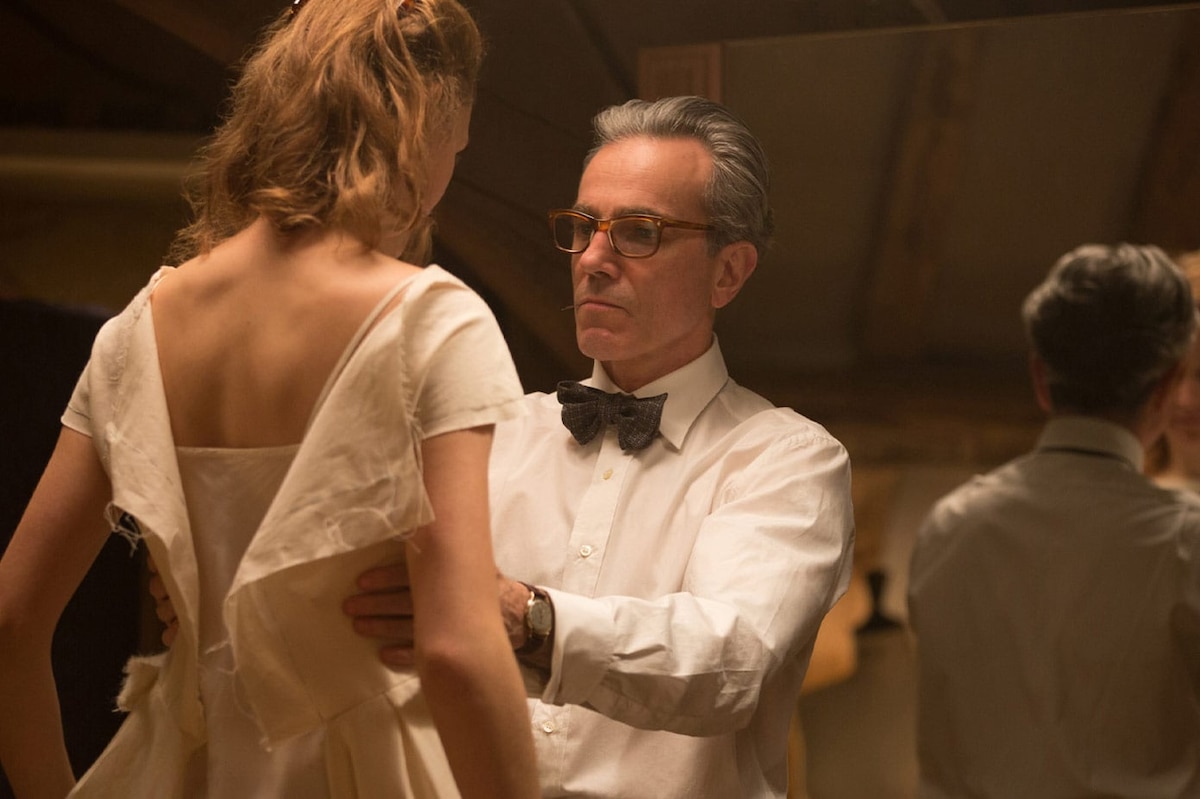
The self-destructive artist is a common trope assigned to creative types who have become so fixated with their form of expression that it consumes them. However, artists work by various degrees of intensity and those truly devoted to their craft can range from simply well-disciplined to being unhinged. There is a polarity artists struggle with: the desire for human connection and the all-consuming drive for their work. This inner turmoil is rife with possibilities for storytelling. Two films in particular, Paris Frills (1945) and Phantom Thread (2017), examine tormented fashion designers who are grappling with both maintaining control over their work and losing some of their control to their muse.
French director Jacques Becker’s film Paris Frills is a melodrama set against the backdrop of a Parisian fashion house. Raymond Rouleau stars as Philippe Clarence, a volatile couturier whose love affair with Micheline (Micheline Presle), the fiancée of his fabric supplier and best friend Daniel (Jean Chevrier), leads to his downfall. Philippe is fastidious and demanding when it comes to his designs and only his no-nonsense business partner Solange (Gabrielle Dorziat) can keep him in check. His biggest challenge comes when he designs a wedding dress for Micheline; a stunning creation that proves to be his undoing.
Released in France as Falbalas (which in French translates to “frill”), the film was made in 1944 during the German occupation and it took a year for it to be released to the public. Production was a stealth operation for Becker whose crew had to hide film equipment and stock throughout the city of Paris. According to film historian John Wakeman, Becker, a former POW during WWII, also used this equipment for La Liberation de Paris (1944), a documentary about the French Resistance. As far as Paris Frills goes, Becker co-wrote the script with screenwriters Maurice Auberge and Maurice Griffe and based much of it on the Paris fashion house his mother operated when he was a child. Becker had a keen sense for fashion and an appreciation for the fashion world. This comes through in the film with the attention to artistic method, design and performance. His star Micheline Presle would remember Becker years later as a devoted fashion lover and “the most elegant person I ever met.”
Marcel Rochas, who ran a fashion and perfume empire with his wife Hélène and was good friends with Becker, was hired as costume designer for the film. According to the official Rochas website, Rochas had developed a reputation as the designer for “the emancipated Parisian woman” and was known for his bold and innovative designs. His biggest contribution to the film was the white wedding dress, beautiful in design and intricacy, that essentially becomes another character in the film. Other style visionaries who worked on the film include art director Max Douy, one of the prominent set designers of French cinema and later known for his work on the James Bond franchise. Actress Gabrielle Dorziat, who plays Solange, was a well-known French socialite and fashion trendsetter. In addition to her long career on stage and in film, she’s best known for championing fashion designer Coco Chanel.
Paris Frills is not considered Becker’s best work. However, it had a profound impact on contemporary fashion designer Jean Paul Gaultier. According to the New Yorker, “Gaultier loved the drama and the romance of the movie, and he also loved the world it described—the mansions where the couturiers worked, the ateliers staffed by legions of stern seamstresses, the precision and the detail of the work. He has said that if he hadn’t seen Falbalas he might not have become a designer.”
Over six decades later, another film about a demanding and temperamental fashion designer came to the surface with Paul Thomas Anderson’s Phantom Thread. Set in 1950s London, the film follows haute couture designer Reynolds Woodcock (Daniel Day-Lewis) who runs his atelier with his sister Cyril (Lesley Manville) and exclusively works with wealthy socialites. When he briefly retires to the countryside, he meets a waitress, Alma (Vicky Krieps), who becomes his lover, model and muse. As their relationship grows in intensity, the power dynamic shifts as these two passionate individuals seek to exert control over the other.
Phantom Thread fits into the world of Paul Thomas Anderson films as it examines dysfunctional relationships, self-destructive personalities and feelings of isolation and regret. Anderson was inspired by Alfred Hitchcock films like Rebecca (1940) and Vertigo (1958) and the character of Reynolds Woodcock was modeled after Spanish fashion designer Cristóbal Balenciaga, who led a quiet life and was often consumed with his work. He also read extensively about the history of fashion design and the term “Phantom Thread” comes from a 19th century notion that a seamstress would weave a part of her spirit into each garment she made. Daniel Day-Lewis did his own research for the role of Reynolds Woodcock by learning to sew, working as an apprentice to designer Marc Happel and studying archival footage of fashion shows from the 1940s and 1950s.
Anderson’s long-time collaborator, costume designer Mark Bridges, worked with his team to create over 50 garments including everyday wear and special designs for the House of Woodcock. According to IndieWire, he studied the work of Balenciaga, Christian Dior, Hardy Amies, John Cavanagh, Charles Creed, Norman Hartnell, and Digby Morton. “Bridges did intense research at the Victoria and Albert Museum (he discovered that ’50s London glorified woolen suits), watched movies such as Maytime in Mayfair, a 1949 British musical comedy about Mayfair’s haute couture ladies’ fashions, and went clothes shopping with Day-Lewis.” Bridges approach to the Woodcock designs were to show the fictional designer as an old-school designer who was still talented but past his prime. Bridges would go on to win his second Oscar for Best Costume Design for his work on Phantom Thread.
When comparing Paris Frills and Phantom Thread, it’s clear that Paul Thomas Anderson drew inspiration from Jacques Becker’s work. Both films feature a dressmaker, fastidious about his work, who often objectifies both the women he sleeps with and those he works with. Both Philippe (Raymond Rouleau) and Reynolds (Daniel Day-Lewis) rely on a right-hand woman, Solange (Gabrielle Dorziat) and Cyril (Lesley Manville) respectively, who both keep the business running while also catering to their boss’s eccentricities. Solange and Cyril can be seen as tamer incarnations of the Mrs. Danvers character in Rebecca. In both stories, a young woman from the country disrupts the life of the fashion designer. Micheline (Micheline Presle) is an orphan from the provinces and Alma (Vicky Krieps) is an Eastern European immigrant working as a waitress in the English countryside. There are also similarities in how both designers work. They run their ateliers in old mansions that also serve to host fashion shows. Reynolds sews messages into the lining of his designs while Philippe names each dress after past lovers or historical women. The name Alma translates to “soul” in Romantic languages and this speaks to both the concept of “Phantom Thread” as well as a line that Rouleau speaks in Paris Frills “a dress with no soul is a dress that wasn’t created for a woman.” Becker’s and Anderson’s films complement each other with their different approaches to a similar portrayal of artistic obsession.
