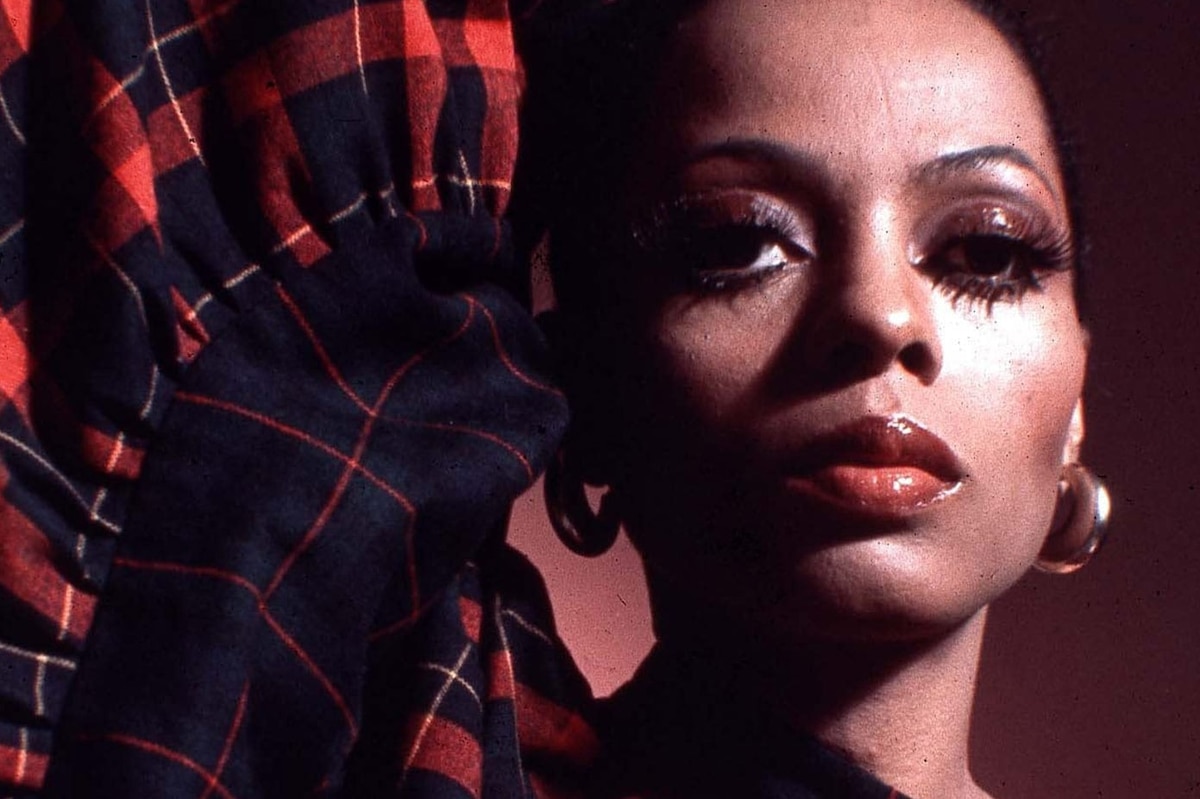
The colors were bold, the platform shoes were high, and bell sleeves were in. The 1970s fashions had a wide range of looks, from prairie to party.
Films of the 1970s serve as a time capsule of showing off these looks, but often the styles were also woven into the storylines. Fashions distinguished the attitudes, class rank or ideas of film characters.
Mahogany (1975)
Tracy (Diana Ross) is an aspiring fashion designer and works as a secretary for a fashion house in Chicago. She falls for activist Brian (Billy Dee Williams), though the two don’t see eye to eye, especially when Tracy could be catapulted into fashion fame, by photographer Sean (Anthony Perkins).
The fashion and costumes in MAHOGANY (1975) are important to the film, not only because the film’s plot focuses on the fashion industry, but because it shows us the role clothing and fashion play in society, particularly during this time period. Throughout the film we see all realms of the fashion world, including the aspects of politics, abuse, classism and racism.
First we see Tracy, an aspiring fashion designer, working as a secretary in an exclusive Chicago fashion house. When hyperactive, cynical fashion photographer Sean spots Tracy on a shoot, he immediately wants her to model for a new fashion spread. Tracy’s boss Miss Evans (Nina Foch) informs him that it’s impossible, because the client is “very conservative,” meaning the client wouldn’t want Tracy in photos because she is Black. Tracy also gets in trouble with Miss Evans and is eventually fired as Tracy continues to sketch fashion designs. Miss Evans wants Tracy as a secretary, and nothing more.
The film shows the juxtaposition between high, expensive couture and every day streetwear. Tracy’s designs are colorful and have sequins, such as a yellow sheath evening gown with a rainbow poncho-style chiffon overlay. She wants her styles to be different than what is currently sold, telling one dress manufacturer about a design with dolman sleeves, where she receives the reply, “What the hell are dolman sleeves?”
But on the winter streets of Chicago, styles differ from the glossy fashion world. Activists, led by Brian Walker (Billy Dee Williams) are protesting the demolition and gentrification of their communities. The protestors wear everyday streetwear of blue jeans and heavy winter coats. Whenever Tracy is amongst Brian’s work, she always stands out with what she’s wearing. While looking for him, Tracy enters an unemployment office in a silky, bright red dress with bell sleeves. Everyone around her is in darker colored clothing, and heavier fabrics.
This juxtaposition is further shown as Sean photographs high fashion in a low-income neighborhood. White models wearing vibrant colored evening gowns are positioned around a rundown apartment building balcony, with local Black neighbors around them in everyday street wear. This fashion shoot illustrates Brian’s political work; showing the area how it is and how it will be in the future when it becomes gentrified.
Tracy eventually travels to Rome with Sean where she transforms into the model, Mahogany, a name that Sean picks because she’s “rich, dark, beautiful and rare.” In Rome, Tracy (as Mahogany) enters an unreal fantasy fashion world. She wears high fashion that many people will never wear — from a sequined bodysuit with purple hair to a voluminous top entirely made of feathers to a medieval-like styled headdress. When Brian visits Tracy/Mahogany in Rome, he notes that she isn’t living in reality and that no one around her is real. While Sean created Mahogany’s image, he also believes he owns her — entering into an abusive, and dangerous, working relationship.
In real life, Diana Ross also had a passion for fashion design, and the film MAHOGANY gave her the opportunity to practice that. “You know, design was my major in school. I designed all the clothes in MAHOGANY. I always wanted to be a fashion designer and I learned costume illustration in high school,” Ross said in a 1981 interview with Andy Warhol.
“When the opportunity to do MAHOGANY came up and I took the script home and realized it was about a fashion designer, I thought to myself, ‘Wouldn’t it be something if I could design the clothes!,’” Ross said in an Oct. 1975, interview. Ross designed 50 outfits for the film, from casual to high fashion. Her Asian-inspired fashion show at the end of the film was inspired by little paper kites she saw in a shop in Los Angeles, Ross said in the interview.
Ross received assistance from Susan Gertsman, who previously was the manager of the Alan Austin Company in Los Angeles. The charity fashion show was designed by Princess Irene Galitzine.
Taxi Driver (1976)
Travis Bickle (Robert De Niro) is a 26-year-old who says he served in the Marines during Vietnam. He’s a loner in New York City and can’t sleep. To fill his time, he takes a job as taxi driver viewing all sides of New York City. He sees political worker Betsy (Cybill Shepherd) and is infatuated, and after a failed date, still tries to contact her. Eventually he berates her in the political office for avoiding him. Travis begins to turn more violent, while fantasizing about rescuing sex worker Iris (Jodie Foster).
The fashions in TAXI DRIVER, designed by Ruth Morley, help show the differences between the characters and their position in society. The styles also serve a purpose in showing how Travis changes throughout the film.
Travis Bickle is an anti-hero outcast. In the start of the film, his clothing is average. He wears blue jeans, a flannel shirt, a short men’s haircut, boots and military-style jackets with military patches.
The staff in Charles Palantine’s (Leonard Harris) political office dress mainstream professional. Tom (Albert Brooks) wears three-piece suits with pastel-colored pink or yellow shirts with a tie. Betsy wears professional A-line cut dresses with balloon sleeves and sometimes an ascot scarf. She also is often braless, which was a feminist fashion statement of the 1970s.
And then there are the people of the streets, like sex workers played by Jodie Foster in the character of Iris. Iris wears sexy 1970s fashion such as hot pants, a floral tied crop top, large sunglasses, platform high heels and wide-brimmed sunhat.
However, as Travis’s character changes, his clothing doesn’t match the styles of the 1970s, particularly in the anti-war, post-Vietnam era. As Travis becomes more violent throughout the film, his look becomes more militaristic and intense. He wears an M-65 field jacket, aviator sunglasses and a mohawk haircut, which wasn’t a popular hairstyle in 1976. GQ magazine calls this a “proto-punk style statement” in a 2016 article.
“The mohawk was something that Marty (Scorsese) and I came up with,” Robert De Niro said at a panel discussion in 2016 during the Tribeca Film Festival. “A friend of his, who was in special forces at that time … showed us a picture of he and his outfit and a couple guys had mohawks ...”
The styles in TAXI DRIVER have continued to inspire fashion designers and trends over the years. In a Fall 2006 runway show, Junya Watanabe tailored looks to look like Travis Bickle, complete with mohawks and military jackets, according to a Jan. 2006 Vogue article. Marc Jacobs’ Spring 2011 line was inspired by Iris’s look, with large hats and hot pants, according to a 2016 Vogue article. Military field jacket looks are still a “fall wardrobe essential,” according to GQ. Most recently, Channing Tatum and Zoë Kravitz made headlines when they dressed as Travis and Iris in their 2021 Halloween costumes.
