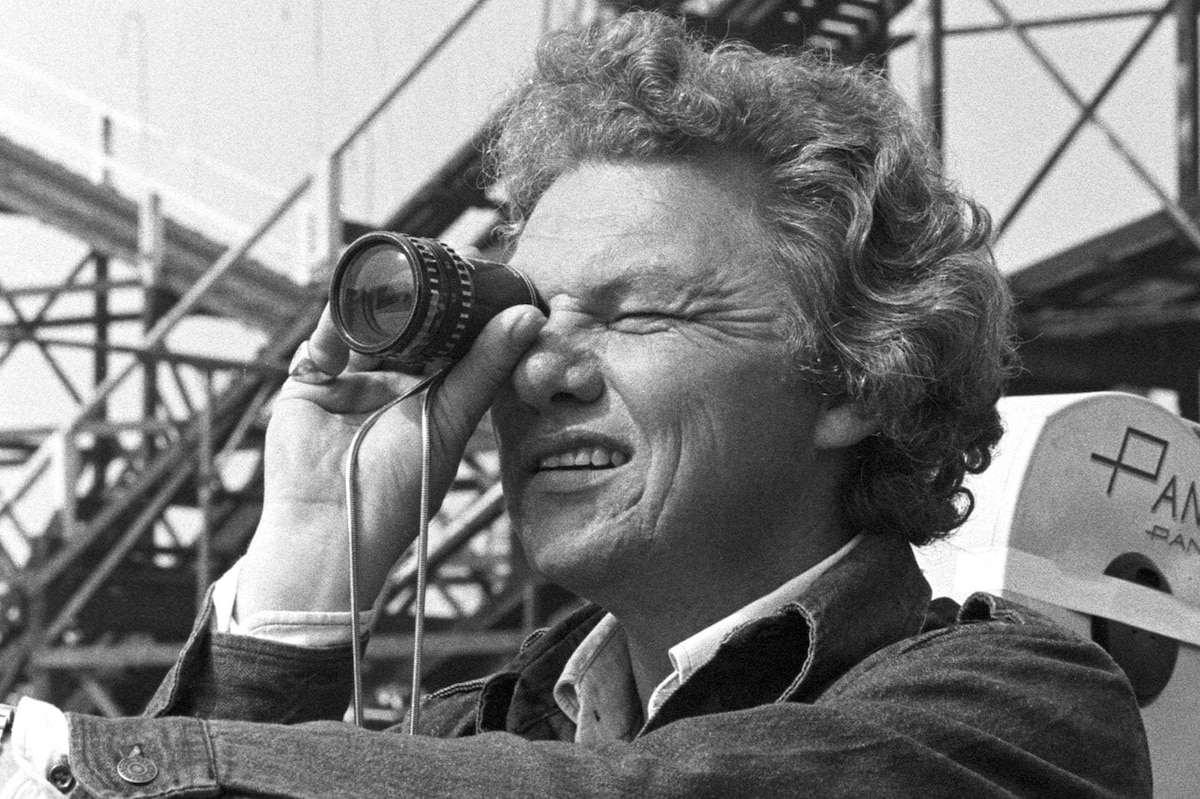
This article was originally written about programming for the TCM Now Playing newsletter in June 2022.
5 Movies | Tuesday, June 7, beginning 8 pm
In their 1984 book, “Masters of Light: Conversations with Contemporary Cinematographers,” Dennis Schaefer and Larry Salvato made a valuable contribution to film scholarship through interviews with 15 of the most accomplished cinematographers of the time, including such acclaimed artists as Michael Chapman (Raging Bull, 1980), Conrad Hall (Butch Cassidy and the Sundance Kid, 1969), Vittorio Storaro (Apocalypse Now, 1979) and Haskell Wexler (Days of Heaven, 1978). Despite all these heavy hitters profiled in the book, the authors don’t hold back when it comes to their esteem for Gordon Willis.
“Gordon Willis is the best cinematographer working in America today. Without a doubt. Period. End of discussion,” they wrote in the introduction to his interview. “And when he gets through rewriting the history of the American cameraman, he will no doubt be considered the most consistently brilliant cameraman this country has ever produced.”
They aren’t alone in their assessment. When the cinematographers they spoke to were asked who of their contemporaries they most admired, Willis (1931-2014) was the overwhelming choice. But at the time of the book’s release, he was barely recognized by the Hollywood establishment. And this was when he had already shot many of Woody Allen’s best films, including Annie Hall (1977), Interiors (1978) and Manhattan (1979); Alan J. Pakula’s so-called “paranoia trilogy,” Klute (1971), The Parallax View (1974) and All the President’s Men (1976); and the first two Godfather movies (1972 and 1974). It wasn’t until 1984 that he received his first Oscar nomination for Allen’s Zelig (1983). His second came for The Godfather: Part III (1990), well over a decade from his landmark work on the first two films in that series. (He finally received an honorary award from the Academy in 2010 “for unsurpassed mastery of light, shadow, color and motion.”) The American Society of Cinematographers finally bestowed a Lifetime Achievement Award in 1995.
Why? Schaefer and Salvato offer their explanation: “Part of the reason Hollywood people have been lax in responding to Willis’s talent is that he is not one of them in a geographical sense. He lives an hour or so outside of Manhattan, with his wife and children, free from all the attendant pressures of Hollywood. Moreover, he has never courted the attention of the press and thus his personal profile is fairly low.”
Then, too, there was his often-expressed antipathy for mainstream Hollywood, of which he once said, “I don’t think it suffers from an overabundance of good taste.”
Ironically, he was born into the motion picture industry; his father was a make-up artist at the East Coast Warner Bros. studios during the Depression. Willis tried acting when he was very young, then got into still photography without much commercial success. During the Korean War, he enlisted in the Air Force and was fortunate to land in a film unit, honing his skills on documentaries. When his military service ended, he got started as an assistant cameraman on the East Coast, particularly in commercials. The advertising gigs gave him good technical experience and knowledge, but the documentary work, including camera operation on the widescreen feature Windjammer (1958), was far more influential in the development of his style.
"You learn to eliminate, as opposed to adding," he later said. "Not many people understand that."
Throughout a feature film career that started with End of the Road (1970), his minimalist approach often brought him into conflict with his directors, many of whom, he once said, have no visual sense.
“They only have a storytelling sense,” he said. “If a director is smart, he’ll give me the elbow room to paint.”
“Everything happens on the set the way Willis wants it to happen,” a colleague noted later in Willis’ career. “That’s power.”
He used that power to fight for the resources and freedom he felt cinematographers needed to make a real difference on a production, whether it was budget increases, better equipment or more time on location. So, despite the years lacking conventional public and industry recognition, he emerged as one of the most influential and successful cinematographers in the business.
Much of that influence lies in Willis’ ability to push boundaries and break rules. Case in point: his work on the first two Godfather films, among the first to be shot with underexposed film at very low light levels and with nearly absolute blacks. None of this was done merely to show off his skills but very much for the sake of the story or what he later described as “the soul of the picture.” Take the sharp contrast between exteriors and interiors in the opening wedding sequence of the first film. The outside scenes are very bright and sunny, what Willis described as an “almost Kodachromey, 1942 kind of feel to it.” When the story cuts to the mafia don’s office inside the house, Willis creates a dark and ominous look to reflect the difference between the “evil” (his word) dealings taking place there and the happy family celebration outside.
Those collaborations with director Francis Ford Coppola cemented his reputation, but Willis was already working against the grain in his earliest films. Hal Ashby’s directing debut, The Landlord (1970), is a sharp social satire about race relations and gentrification set in Brooklyn (a cost-saving shift from the source novel’s Philadelphia) that opened to positive reviews and good box office but is largely neglected today. On this, his third feature and the first to credit him as director of photography, Willis worked against the standard recommendation for the Eastman color film he was shooting, essentially underexposing to achieve a look he described as “more translucent. You can see through the colors, rather than having them just sticking on the screen…a kind of foggy, not-quite-there look.” (American Cinematographer interview)
Klute was the first of six collaborations between Willis and director Alan J. Pakula. (They worked together on what would be the final film for each of them, The Devil’s Own, 1997.) Willis’s work on this picture would prove to be game-changing. For the first time, he employed lighting from above to create deep shadows on the actors’ faces and evocative silhouettes. The result was a moody noir-like atmosphere with key elements of some shots partially obscured, earning him the nickname (via Conrad Hall) “The Prince of Darkness.” Again, the technique was not for show but fully in support of the psychosexual pathologies explored in this dark thriller about a call girl (Jane Fonda in an Oscar-winning role) at the center of a police hunt for a serial killer. Willis’s work was bold for its time, but the style soon permeated many of the most significant movies of the 1970s and beyond.
Pakula wasn’t his only frequent collaborator. Sixty percent of Willis’s credits have been with just four directors. When asked why, Willis gave two reasons. “First of all, they want you back, which is kind of nice because that’s a hard relationship to build. And then the bottom line is if you can do better movies with certain people than you can with other people, then why not do it? It’s getting along with that particular person at a level which is suitable for both of you.” (Masters of Light)
When one of those directors, James Bridges, was asked to salvage a failing production of Bright Lights, Big City (1988), the screen version of Jay McInerney’s best seller about a disillusioned young writer who turns to drink and drugs, he agreed only if he could scrap all the existing footage and start over with Willis as his DP. After working together on The Paper Chase (1973), September 30, 1955 (1977) and Perfect (1985), he knew Willis could capture the late 80s New York setting and mood of the story with its shifting atmosphere between staid corporate offices and self-destructive nightlife.
The director Willis worked with the most, however, was Woody Allen. Willis lensed most of the films in what is considered the director’s Golden Age, an eight-picture run from Annie Hall through The Purple Rose of Cairo (1985).
"Gordon was so brilliant,” Allen said of their initial collaboration on Annie Hall. “He would say to me, 'Look, it doesn't matter if it's very, very dark there and you don't see anything. They'll still think it's funny.’ My maturity in films began with my association with Gordon Willis."
Allen often prefers to shoot in black-and-white, for which Willis is ideally suited. In fact, he has said that even on his color films, he shoots as if he were working in monochrome.
“There are differences obviously from the standpoint of what you have to pay attention to, but as far as lighting ratios and the feel of color on the screen, I feel the same emotionally with that as I do with black-and-white,” he told Schaefer and Salvato. “I handle it basically in the same way on a narrative level; if something special is taking place, obviously you step out of line to do it. Lighting ratios and feelings are the same in my mind. I transpose the same way. Mechanically you have to execute two different ways, but I transpose them the same way in my mind.”
Although some critics prefer the stark, Fellini-esque look of Stardust Memories (1980), Willis’s most memorable black-and-white work for Allen is still Manhattan, a neurotic (and these days considered problematic) love story set among the intellectual elite of Manhattan.
“Woody and I both see New York as a black and white town, and I love shooting wide-screen anamorphic. Put the two together and look in the right direction, and you get the romantic reality of Manhattan.”
The opening alone, a sequence of shots of the city culminating in a fireworks display over the skyline, remains one of the most iconic evocations of New York ever put on celluloid and perfectly sets the bittersweet comic tone of the film.
Working outside his usual realm of repeat collaborators, Willis brought all his skills to bear, in both color and black-and-white, on Pennies from Heaven (1981), the story of a ne’er-do-well dreamer (Steve Martin) who lives in an untenable fantasy world of 1930s music and film. This unique musical drama shifts between tones of hope vs. dread, romance vs. isolation and warm nostalgia vs. cold desolation. Willis skillfully captures this heady mix with gaudy color, his propensity for placing characters in deep shadows and a recreation of the austere eeriness of Edward Hopper’s paintings from the period.
"It's common knowledge among his peers, film critics and cinephiles that (Willis) stands beside Griffith, Welles and Ford as one of the great originators," said Richard Crudo, president of the American Society of Cinematographers. "Just as those men did before him, he not only changed the way movies look, he changed the way we look at movies."
