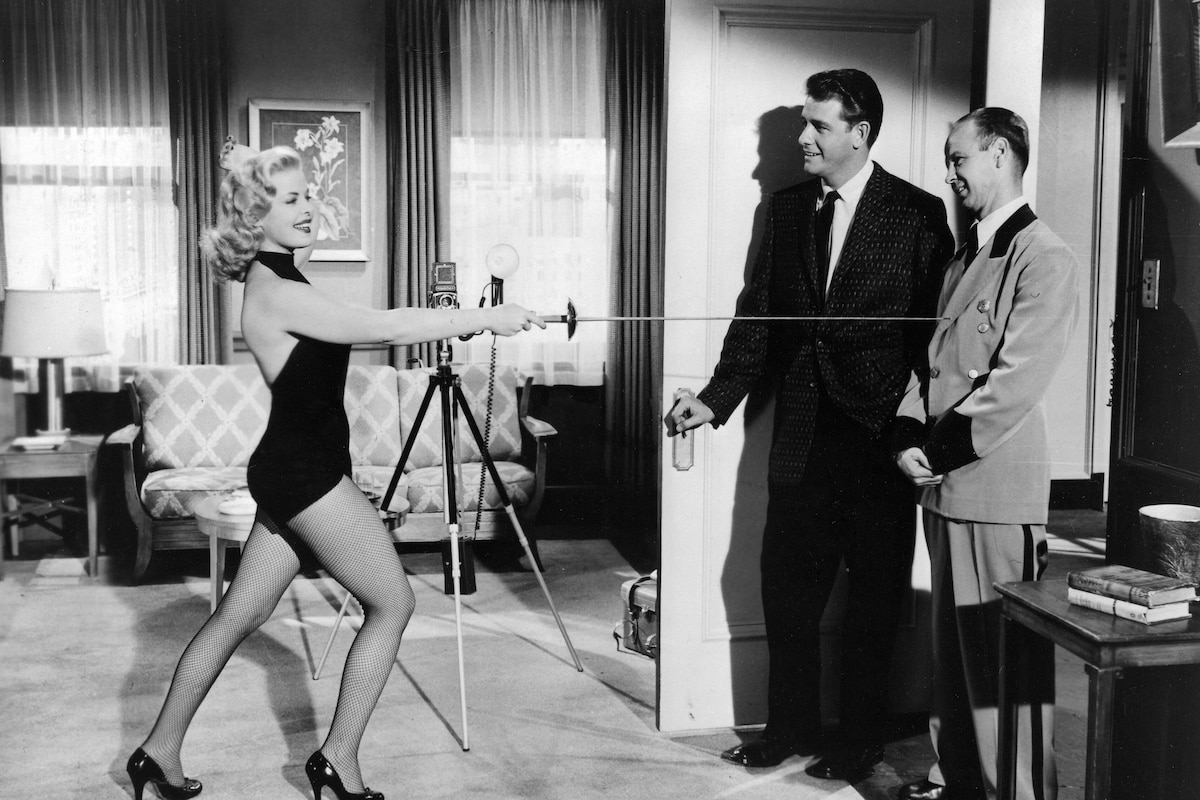
Shot over two weeks in October 1955, Over-Exposed was released in April 1956 by Columbia Pictures. A minor programmer, the film is nonetheless of interest for being one of the earliest feature films for actor Richard Crenna and the next-to-last picture for blonde bombshell Cleo Moore.
As The New York Times put it in 2010, “Moore’s specialty was the working-class girl struggling to get by in a man’s world without compromising too much of her virtue.” Sure enough, her character of Lila Crane in Over-Exposed starts out by being arrested for soliciting drinks at a nightclub. The small-town girl then meets a photographer (Raymond Greenleaf) who shows her the ropes of his trade, and she determines to become a photographer herself. She sets off for New York and befriends a handsome reporter (Crenna) when she applies for a job at his news service. Gradually, she finds success but also gets mixed up with gangsters, leading to a dangerous denouement.
Moore was a 1950s B-film sex symbol who was frustrated at being pigeonholed as such. According to Variety, she asked for a release from her Columbia contract after the studio forced her to do press for this film instead of accommodating other studios’ requests for loaning her out. Over-Exposed was thus her final Columbia film, though she did star in one more picture, the United Artists release Hit and Run (1957), for low-budget producer-director Hugo Haas, with whom she had already made several films. Hit and Run bombed, after which Moore retired from showbiz and married a real estate developer.
One interview she did for Over-Exposed, for the April 1956 issue of Modern Screen, illustrates the kind of thing she was frustrated about being forced to discuss. Asked about her wardrobe in this movie, she said, “I have four luscious evening gowns, eight street dresses, a couple of cocktail suits, and best of all, four nightgowns that will make all women throw away their pajamas. I have one evening gown that is black lace on nude-colored fabric as well as a blue-and-green sequined form-fitting gown, extremely revealing. I also have a 22-carat gold jersey bathing suit.”
This was also the next-to-last film for director Lewis Seiler, an able veteran whose career in the motion picture industry stretched back to 1919. Seiler had previously directed Moore in the cult classic Women’s Prison (1955) starring Ida Lupino.
Over-Exposed drew unremarkable reviews from the trade press. The Motion Picture Exhibitor called it an “average programmer... The photographic angle [provides] perhaps a little more than usual opportunity for cheesecake to creep in.”
Variety declared, “Cleo Moore, better known to filmgoers as Hugo Haas’ leading lady, attains star status in Over-Exposed, a mild meller for the program market... Star’s generous proportions obviously provide exploitation angles but paradoxically have nothing to do with the title... Performances generally are on par with the shaky story. While Miss Moore makes a nice try in the role of the photog who made good, she seldom is credible... Raymond Greenleaf, however, etches a neat portrayal of the aging but kindly photographer.”
Motion Picture Daily especially praised the work of 30-year-old Richard Crenna: “Standout performance by Richard Crenna might well be a box-office ‘find’ in Columbia’s modestly budgeted film. [Crenna’s] performance could serve as a springboard to starring roles.”
Sure enough, within months Crenna would start a six-year run in the popular TV show The Real McCoys, followed by a notable turn in the 1960s series Slattery’s People. Twenty years later he would reach many more fans with his turn as Col. Trautman in three “Rambo” movies.
