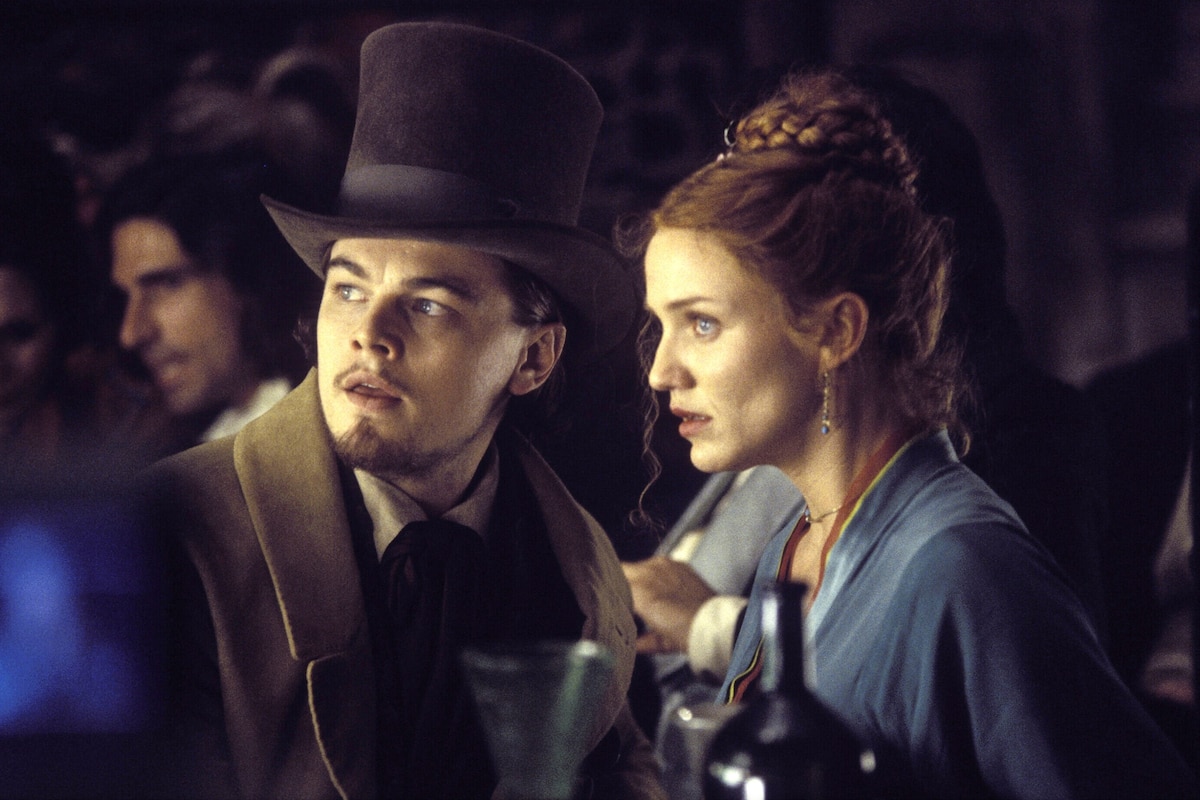
Martin Scorsese’s Gangs of New York (2002) finds the historical roots of the ongoing debate about immigration in the U.S. in the conflicts in 1840s New York between native-born Protestants and Irish-Catholic immigrants. An all-star cast headed by Leonardo DiCaprio, Daniel Day-Lewis, Jim Broadbent and Liam Neeson, many of them playing characters based on actual historical figures, brings to life a turbulent two decades that helped set the tone of American democracy. The film also marks the first collaboration between Scorsese and DiCaprio, who would go on to make five more films together, with a sixth, Killers of the Flower Moon, slated for release in 2022. DiCaprio was so eager to make the film he even changed agents.
The film covers almost two decades, starting with a violent gang war pitting Bill “The Butcher” Cutting’s (Day-Lewis) Nativists against “Priest” Vallon’s (Neeson) Irish-Catholic Dead Rabbits. Bill kills Priest in battle, and years later Priest’s son (DiCaprio) returns to New York seeking revenge. He works his way into Bill’s confidence until his identity is revealed. This sets the stage for a violent confrontation against the backdrop of the 1863 Draft Riots, during which tens of thousands of armed men and women took to the streets to protest the institution of a draft that unfairly targeted the poor.
Scorsese had long been fascinated with New York history. In 1970, he read Herbert Asbury’s 1927 book “The Gangs of New York: An Informal History of the Underworld.” He optioned the film rights in 1977 but was not yet well-enough established as a filmmaker to get financing for an expensive historical epic.
DiCaprio’s interest helped land the film at Harvey Weinstein’s Miramax Films in 1999. Scorsese had already been working on the script with Jay Cocks, with whom he had worked on The Age of Innocence (1993). They built their plot around real-life figures like Bill ‘The Butcher’ (whose real surname was Poole) and Boss Tweed, while adding a fictional story with characters they created for the film. He brought on Steven Zaillian to help re-structure it and Kenneth Lonergan to deepen the characterizations. The script was not finished when the film started shooting in December 2001.
Scorsese initially announced Robert De Niro as Bill “The Butcher,” but he withdrew because of a scheduling conflict. After Willem Dafoe turned it down, Day-Lewis came on board for his first film role since 1997.
New York had changed so much it was impossible to film exteriors there. Instead, Scorsese took the production to Rome’s Cinerite studios, where the art department under Dante Ferretti’s supervision built more than a mile of mid-19th century city streets. Among the locations they duplicated were the Five Points slum, the East River waterfront with two full-sized sailing ships and Tammany Hall, headquarters of the political organization that ran New York State for well over a century and a half. Costume designer Sandy Powell, (Shakespeare in Love ,1998; Scorsese’s The Aviator, 2004) had to create costumes for the lower echelons of society by attacking the fabrics with sandpaper and graters and hanging them with weights in the pockets so they would look appropriately worn.
Since national origins play an important role in the conflict, Scorsese hired dialect coach Tim Monich to work with the actors to create dialects specific to their countries of origin. To recreate how working-class native-born New Yorkers spoke in the mid-19th century, Monich studied period poems and songs and the police department’s “Rogue’s Lexicon,” a dictionary of criminal slang. With DiCaprio, he developed an accent that reflected both his character’s Irish birth and his U.S. upbringing. Monich also advised the actors on what slang terms would have been used in that era, so that they knew to refer to addicts as “hop fiends” rather than “dope fiends” and to call the British “lime juicers” rather than “limeys.”
Known for his painstaking research into characters, Day-Lewis prepared for the role by reading everything from the Police Gazette to the poems of Walt Whitman. He studied butchery in a Queens meat shop and flew in a master of the art from London to give him some fine points. He never broke character during filming, even when Scorsese and DiCaprio persuaded him to join them for dinner, which terrified their waitress.
Scorsese and Weinstein clashed throughout the production over Scorsese’s vision and the film’s length, causing delays that drove the budget to about $103 million and postponed the planned 2001 release for more than a year. Miramax also feared certain scenes would upset audiences so soon after the 9/11 attacks. The film’s final shots of modern-day New York included the World Trade Center. There was talk of removing the towers digitally, but Scorsese and Miramax ultimately decided to leave them in. After delivering a work print that ran more than three hours, Scorsese, with some prodding from Weinstein, cut the film to its current two hour and 47-minute length.
Originally, Weinstein wanted to release the film on Christmas Day, 2002. That created a conflict for DiCaprio, whose Catch Me If You Can (2002) was also slated to premiere that day. Weinstein was eventually convinced that Gangs of New York was not really a Christmas movie, and the release was moved to December 20, so the film would still qualify for year-end awards, which seemed likely given critical response.
Variety’s Todd McCarthy called it “a richly impressive and densely realized work that bracingly opens the eye and mind to untaught aspects of American history.” The film was listed in more than 15 year-end ten-best lists, including those of Rolling Stone, Time Magazine and The New York Times.
Daniel Day-Lewis got Best Actor Awards from the New York Film Critics, the Los Angeles Society of Film Critics, the Screen Actors Guild and the British Film Academy, among others. Scorsese won Best Director at the Golden Globes. The picture received ten Oscar® nominations, with Day-Lewis particularly favored to win. On Oscar® night, however, it came up empty handed, with Chicago (2002) dominating most of the craft awards and beating it for Best Picture. Scorsese lost Best Director to Roman Polanski for The Pianist (2002), while Best Actor went to Adrien Brody for the same film.
Source:
Bordewich, Fergus. “Martin Scorsese’s Meanest Streets Yet: Rediscovering the 19th Century Gangs of New York.” Smithsonian Magazine (December 2002)
