5 Movies | November 25, 8 p.m.
These days the plots of movies set on Thanksgiving often revolve around family or personal secrets, festering animosities and political, sexual and cultural biases and misunderstandings as relations come from near and far, dragging their emotional baggage, for contentious gatherings that somehow work out by the final frame. This year, take a break from all that – and from the never-ending football and leftovers – with these five comedies about families with an entire range of other dysfunctions.
The holiday itself doesn’t necessarily play a part in these stories, but children – lots and lots of unruly, precocious and/or just plain irritating children – do. In Houseboat (1958), Cary Grant plays an absentee father suddenly stuck with three hostile kids when his estranged ex dies. Adding to his woes are romantic complications in the form of an on-and-off girlfriend (Martha Hyer) and a sexy nanny who helps Grant overcome his parenting difficulties (Sophia Loren, reteamed with Grant after their palpable chemistry in The Pride and the Passion, 1957).
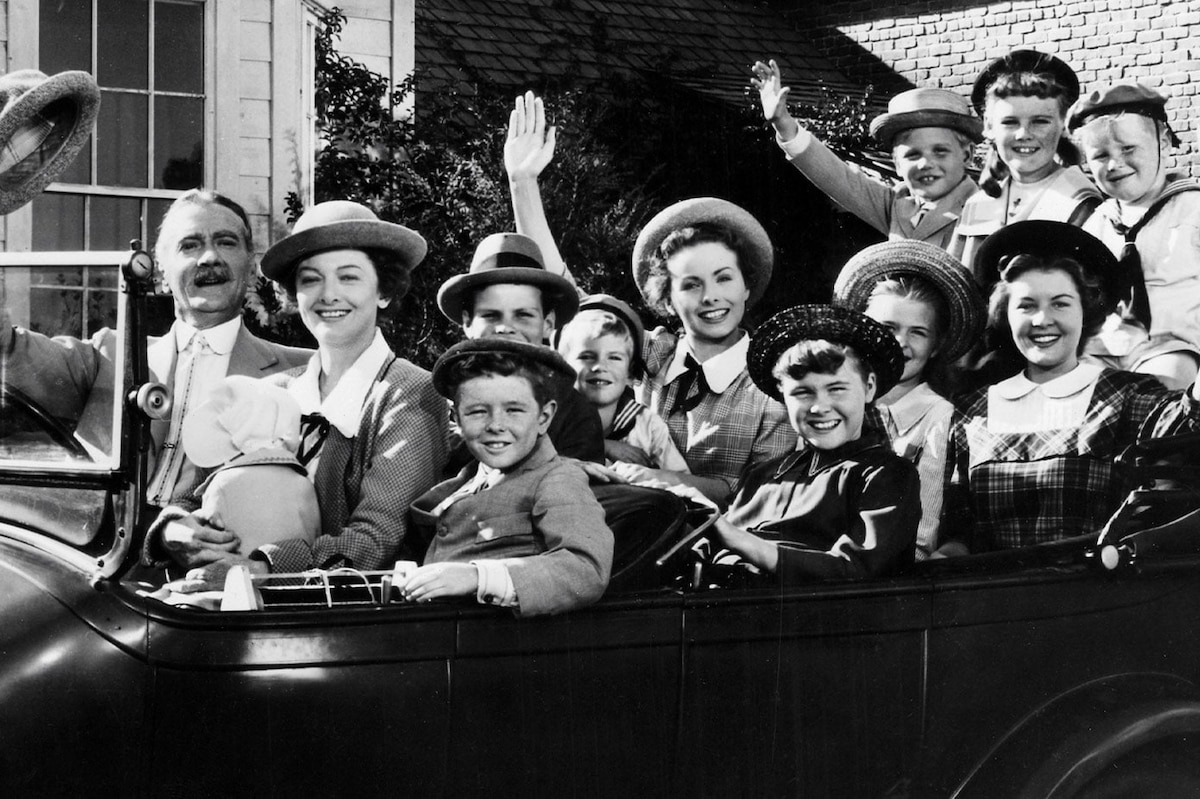
The strain of living with a large family is multiplied fourfold in Cheaper By the Dozen (1950), an episodic tale in which Clifton Webb and eternal wife Myrna Loy raise six boys and six girls. The story is based on a real family, as told in a book written by two of the children, and it culminates in the mother becoming a leading industrial engineer and 1948’s Woman of the Year. The basic premise, but not the plot details, was reworked for a same-named Steve Martin film in 2003.
A widower with ten children marries a widow with eight in Yours, Mine and Ours (1968), a proto-Brady Bunch story with Henry Fonda and Lucille Ball as the lucky(?) couple, who must have been well into their 50s when they had the youngest of their broods. Like the earlier film in this program, this is based on a real-life couple, Helen and Frank Beardsley, who landed on talk shows and the game show I’ve Got a Secret thanks to their remarkable family of 20 children (they had two more after they married in 1961 at a considerably younger age than Fonda and Ball).
The couple played by James Stewart and Maureen O’Hara in Mr. Hobbs Takes a Vacation (1962) have far fewer children (only four), but that doesn’t stop the kids from ruining Stewart’s planned romantic getaway when his wife invites them all – plus their spouses and offspring – to join them on their beach holiday. Based on a novel, but not a true story, by Edward Streeter, the picture was never directly remade but reportedly served as a loose inspiration for National Lampoon’s Vacation (1983) and its sequels.
We’re back to real life, of sorts, in Please Don’t Eat the Daisies (1960), based on a book by author and playwright Jean Kerr, wife of powerful New York theater critic Walter Kerr. The fictionalized plot concerns the tribulations of Kate and Laurence Mackay (Doris Day and David Niven) as they try to raise four rambunctious sons in a Manhattan apartment. His career takes off just as the family finally movies into a more spacious home outside New York City, where tensions mount between home and career, city and suburb, the social whirl and family life. The story makes some use of Kerr’s reputation for being one of the harshest critics of Broadway productions, particularly musicals. (He famously panned Company, Follies, West Side Story and Beckett’s Waiting for Godot.)
