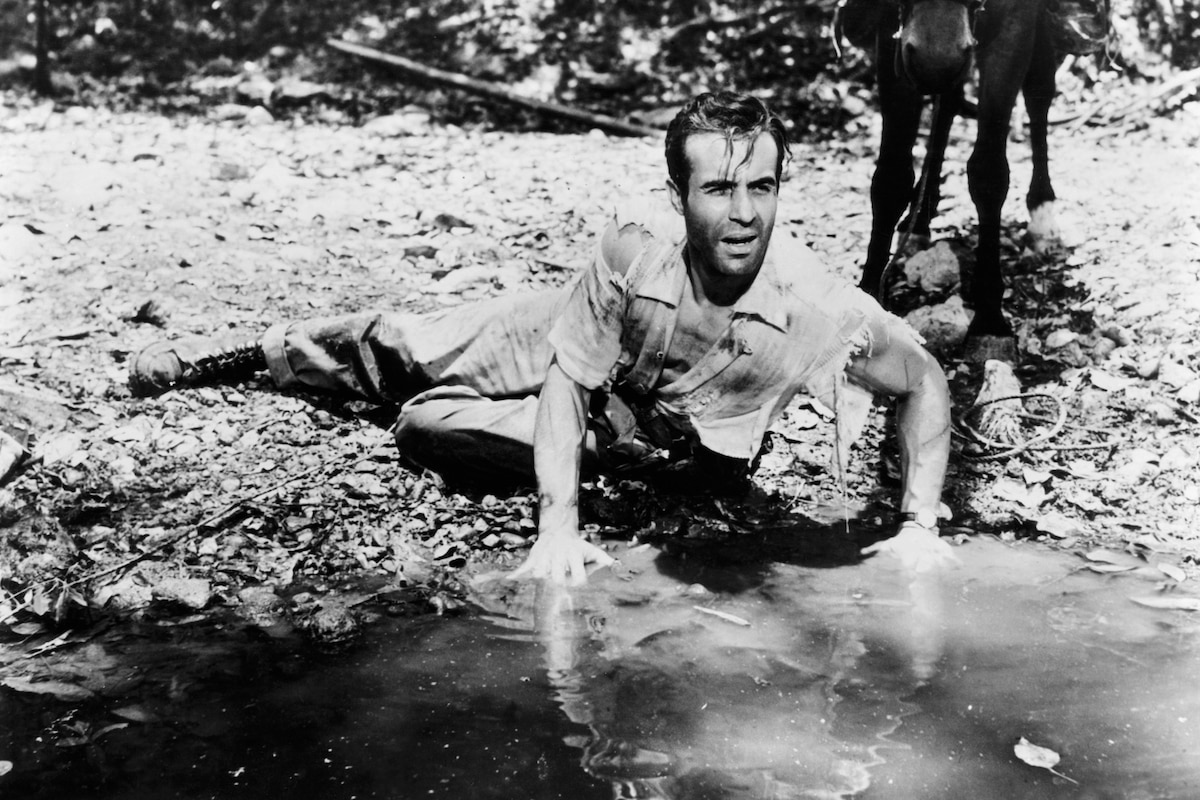
Untouched (1954), the American release title of the Mexican melodrama Sombra Verde (which literally translates as Green Shadow), finds Ricardo Montalban as a pharmaceutical company scientist who ventures into the Mexican jungle in search of barbasco roots, used for the making of cortisone. After his partner is killed and Montalban loses his way, he becomes entangled with an unhinged, murderous farmer (Jorge Martinez de Hoyas) and the farmer’s sultry daughter (Ariadna Welter) on a paradisal hidden plantation, in what is a narrative variation on The Tempest.
According to UCLA’s Jan-Christopher Horak, “Norman Foster wrote the first script, which was to be produced for 1.8 million pesos, originally in color and two versions (Spanish and English), but cost overruns limited the production to black and white and Spanish only.” The film was produced by the prolific Calderon brothers, Guillermo and Pedro, who invited Montalban back across the border to his home country for a breather from his Latin lover roles in MGM musicals and comedies. Montalban, a major Hollywood star, was tired of playing caricatures, though he had also occasionally played grittier, more three-dimensional characters in such film noirs as Border Incident (1949) and Mystery Street (1950)
Untouched was directed by Roberto Gavaldon, one of the finest directors during Mexico’s cinematic heyday of the 1940s and 1950s (though he worked until 1979). An excellent craftsman and visual storyteller, Gavaldon started as an extra in Hollywood at the dawn of sound before returning to Mexico and working his way up as assistant director and then director, turning out many popular and critically acclaimed pictures. He is best known today as a master of Mexican film noir, with such titles as The Kneeling Goddess (1947), Night Falls (1952) and the masterpiece La Otra (1946). He was prolific and eclectic: among Gavaldon’s 50-odd credits is The Littlest Outlaw (1955), one of Walt Disney’s earliest live-action features, which was filmed in Mexico.
Untouched was released in the United States in 1956 in a dubbed version and in 1957 in subtitled form. In the 2010s, it was restored by Mexico’s Permanencia Voluntaria and the UCLA Film & Television Archive.
SOURCES:
Ela Bittencourt, “Roberto Gavaldon’s Mortal Visions,” mubi.com, 4/25/19
Jan-Christopher Horak, UCLA Film & Television Archive online notes on Sombra Verde
Laura Boyes, Moviediva.com article on Sombra Verde
