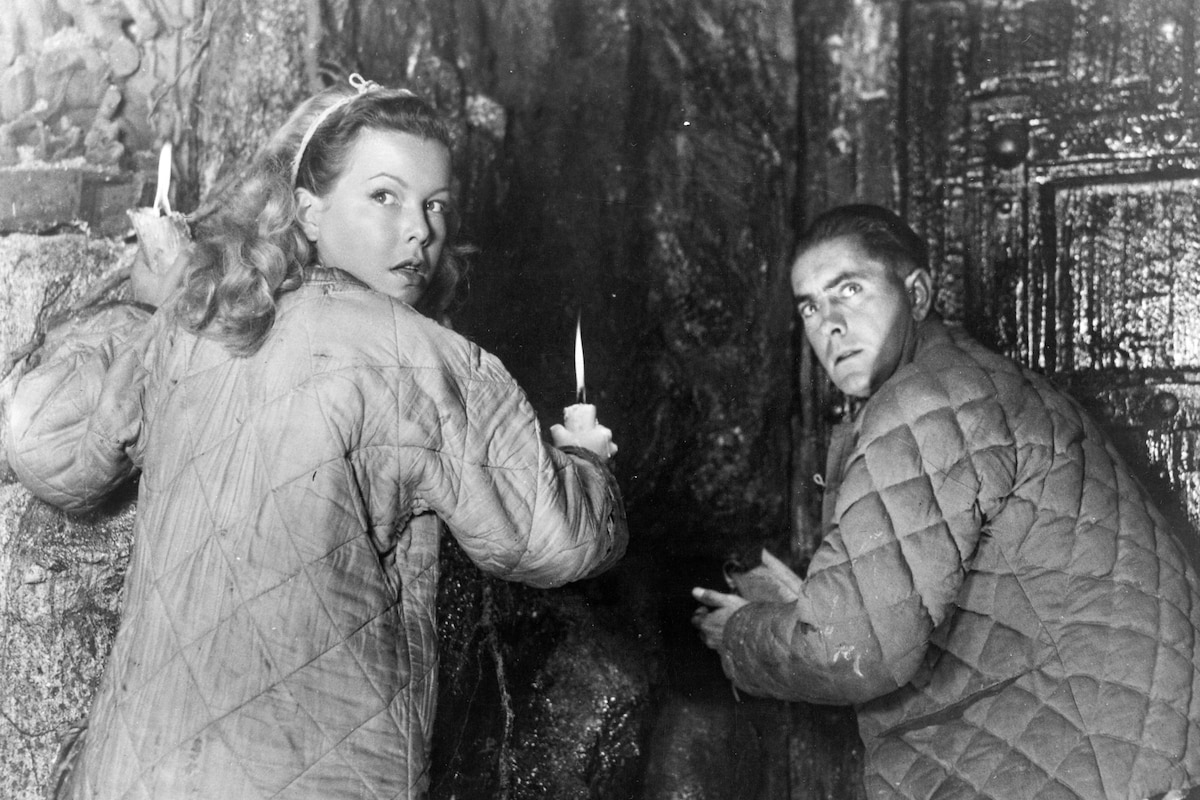
The Black Rose (1950), a 13th-century historical adventure, stars Tyrone Power as a disinherited Saxon who flees England for China before he must attempt an escape back to England. Produced by Twentieth Century-Fox and filmed in lush Technicolor, it was among Power’s last pictures for Fox before he ended his contract in 1952 to go freelance. After having finally gotten the chance to play a meaty drama against type in Nightmare Alley (1947), the studio had simply plunged him back into the swashbucklers of which Power had grown weary, starting with Captain from Castile (1947).
As Jeanine Basinger wrote in The Star Machine, “enthusiasm for film work began to die inside Power. His disappointment showed onscreen. He often seemed to be walking through his roles. Sadly for his ambitions and talents, his disillusionment affected his work and he began to look like an aging movie star whose ability was limited, a former pretty boy who couldn’t act. He became less than he was.”
Fox had actually bought the rights to Thomas B. Costain’s novel The Black Rose in the autumn of 1945. Filming was set to start in July 1947 (immediately following production on Nightmare Alley) but was canceled due to rising production costs overall at the studio; the film’s estimated $3.2 million budget was seen as too high. Still, when production was greenlit for a second time in 1949, the budget was $3 million, very high for the period.
Shooting finally began in Morocco in April 1949 with a mostly British crew numbering over 100. Interiors were later shot at Shepperton Studios and in two English castles. Joining Power in the cast were Orson Welles (who had also just appeared with him in 1949’s Prince of Foxes), Jack Hawkins, Michael Rennie, Herbert Lom, Alfonso Bedoya (who according to one source was dubbed by Peter Sellers), Robert Blake and Laurence Harvey. The leading lady part of Maryam was offered to Leslie Caron, in what would have marked her film debut, but Caron’s mother did not approve, and the role went to Cecile Aubry instead. (Caron would make her debut in An American in Paris [1951].)
Guiding this army of cast and crew was director Henry Hathaway, known for action-filled Westerns, noir and adventure films. He also had a reputation as a difficult taskmaster. Cinematographer Jack Cardiff later said Hathaway “was a toughie... He fired so many people that we had a plane called the Hathaway Special which used to fly people every couple of days back to England... [Hathaway] would die for that picture. He expected everyone else to die for the picture. And if they were not ready to die, he would just crucify them.”
In an interview with Ronald L. Davis, Hathaway later dismissed the film. “It was cast badly,” he said. “Jack Hawkins...was too old for his part. It should have been played by someone like Van Johnson... I didn’t have a good time making that picture. If you don’t have a good time, the picture doesn’t turn out well.” Hathaway also said that this was the first film he made after a cancer operation, and a doctor was hired to monitor him all through production – likely part of the reason the filming was not enjoyable for him.
Jack Hawkins, who plays Power’s archer friend, later wrote that Power “was a joy to work with, [and] became one of my closest friends.” Hathaway, he wrote, “taught me filming the tough way.” For one particular scene, Hawkins “had to shoot [an arrow] over the camera in the general direction of a target that had been set up as a guide. The camera crew certainly had no confidence in my ability to shoot straight, and when I stepped out in front of the camera, they were rather pointedly cowering under a makeshift shield of sheets of thick cardboard. I drew the bow and let fly and, to everyone’s astonishment, including my own, the arrow landed in the center of the target. Henry Hathaway came up and said, ‘God damn it, you hit it!’ ‘Naturally,’ I replied with dignity. ‘I have been practicing extremely hard for the past six weeks.’ ‘OK. But don’t overdo it!’”
Hawkins was nonplussed and told Hathaway he would not care if he was sent home and replaced by someone else. After that, he wrote, the two men got along, although Hawkins maintained that the director “made everyone’s life hell” on the set.
Years later, Hawkins realized that “beneath his harsh exterior, [Hathaway] concealed a kindly nature.” After Hawkins lost his voice following surgery for throat cancer in 1966, Hathaway was the first colleague to help him resume his career, by hiring him to help produce The Last Safari (1967) on location in Kenya, which “proved a tremendous boost to my confidence.”
The Black Rose is notable for the beautiful Technicolor photography by Jack Cardiff, one of the great masters of light in film history. Around the time of this film, Cardiff was arguably at his artistic peak, shooting such visual feasts as A Matter of Life and Death (1946), Black Narcissus (1947), The Red Shoes (1948), Pandora and the Flying Dutchman (1951) and The African Queen (1951). As he said in a 2005 interview, “I looked at each frame as a painting and then the camera became my paintbrush.”
Cardiff remembered Orson Welles agreeing to play a Mongolian general in The Black Rose on the condition that his coat in the film would be lined with mink – even though the lining would never be seen by the audience. It turned out this was a crafty way for Welles to snag a good-looking costume for his film of Othello (1951), which he spent years making in bits and pieces. When his part in The Black Rose was finished, Cardiff said, “Welles slipped off with the coat... and turned [it] inside out so that he had a mink coat for Othello.”
SOURCES:
Jeanine Basinger, The Star Machine
Cameraman: The Life and Work of Jack Cardiff, documentary directed by Craig McCall, 2010
Ronald L. Davis, Just Making Movies
Jack Hawkins, Anything for a Quiet Life
Dennis McLellan, “Jack Cardiff Dies at 94,” Los Angeles Times, 4/23/09
