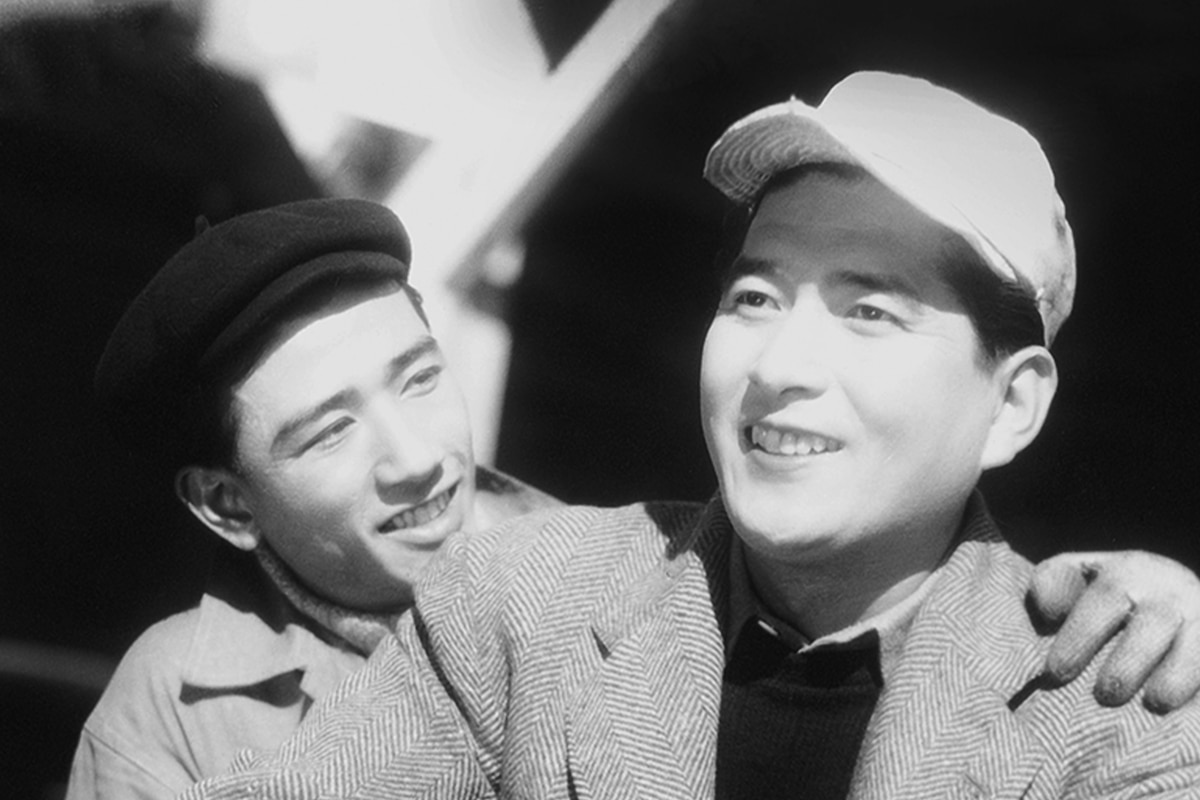
Following the defeat of Japan in World War II in 1945, the country was governed for several years by the Allied Supreme Command (primarily the U.S.), which instituted a management system for the country’s film production that lasted until 1952. A list of banned subject matter issued in 1945 included nationalism, patriotism, suicide, brutal violence and more. Historical drama, then, became virtually impossible and approved contemporary settings and themes become the norm.
One favored theme of the occupying forces was the breaking down of class and social barriers traditional to Japanese society up to that point. Many movies from this era depict families seeking suitable marriages for their “aging” daughters, often across class or social lines. Director Yasujirō Ozu, one of the country’s most acclaimed and enduring filmmakers, practically cornered the market on such stories with films like Late Spring (1949) and Early Summer (1951), both starring Ozu regular Setsuko Hara. Her presence here as another late-20s marriageable daughter might lead one to expect the same kind of gentle family drama, but the director of Here’s to the Young Lady, Keisuke Kinoshita, put his own spin on the theme, creating a charming romantic comedy.
An aristocratic family fallen on hard times pushes a relationship between their daughter, Yasuko (Hara) and Keizô (Shûji Sano), a wealthy self-made man from a humble background. The prospective groom is thrilled at first to be courting such a desirable woman until he learns that he has been chosen to rescue the penniless family from the loss of their privileged lifestyle. In an ironic twist, the successful young man finds himself opposing a union between his younger male friend and a woman Keizô considers beneath his station.
The plot has all the elements of a weepy melodrama, but Kinoshita, working from a script by fellow writer-director Kaneto Shindô, finds plenty of humor, particularly in the frequent social faux pas committed by Keizô, although many of them are so tied to Japanese conventions that American viewers may not spot them very easily (e.g., buying her a piano, sending her home in a taxi). Any audience, however, can enjoy the sight gags peppered throughout, such as the way Yasuko’s family enters the room when they’re meeting Keizô for the first time – one by one, forcing everyone to stand and bow each time – or Hara’s pratfall after returning home from a date.
Sano was often cast at this time as a quiet, well-mannered middle-class male, but here he brings a fun sense of awkwardness and bewilderment to the role of the suitor. Because Shindô was not known for comedy, either in his self-directed films or in the scripts he wrote for others, the Japan on Film blog speculates that perhaps Kinoshita “took a standard vehicle for Hara and by simply changing the way Sano played a few scenes and inserting a number of sight gags, he came up with an entirely different movie than the studio expected.”
Although many Japanese filmmakers found themselves barred from working during the Occupation, Kinoshita was able to continue the directing career he began in 1943, thanks to such career moves as bucking Imperial Japanese censors on the downbeat ending to his military drama Army (1944). Once free from the constraints of the Allied oversight of the country’s film production, he was able to expand his range, notably in perhaps his most internationally known work, the Kabuki-inflected historical drama The Ballad of Narayama (1958), a nominee for the Golden Lion at the Venice Film Festival that year. Not as famous globally as contemporaries Kurosawa, Mizoguchi and Ozu, he was nevertheless a popular and critical success in Japan through his final film, Father (1988), released 10 years before his death in 1992 at the age of 86.
