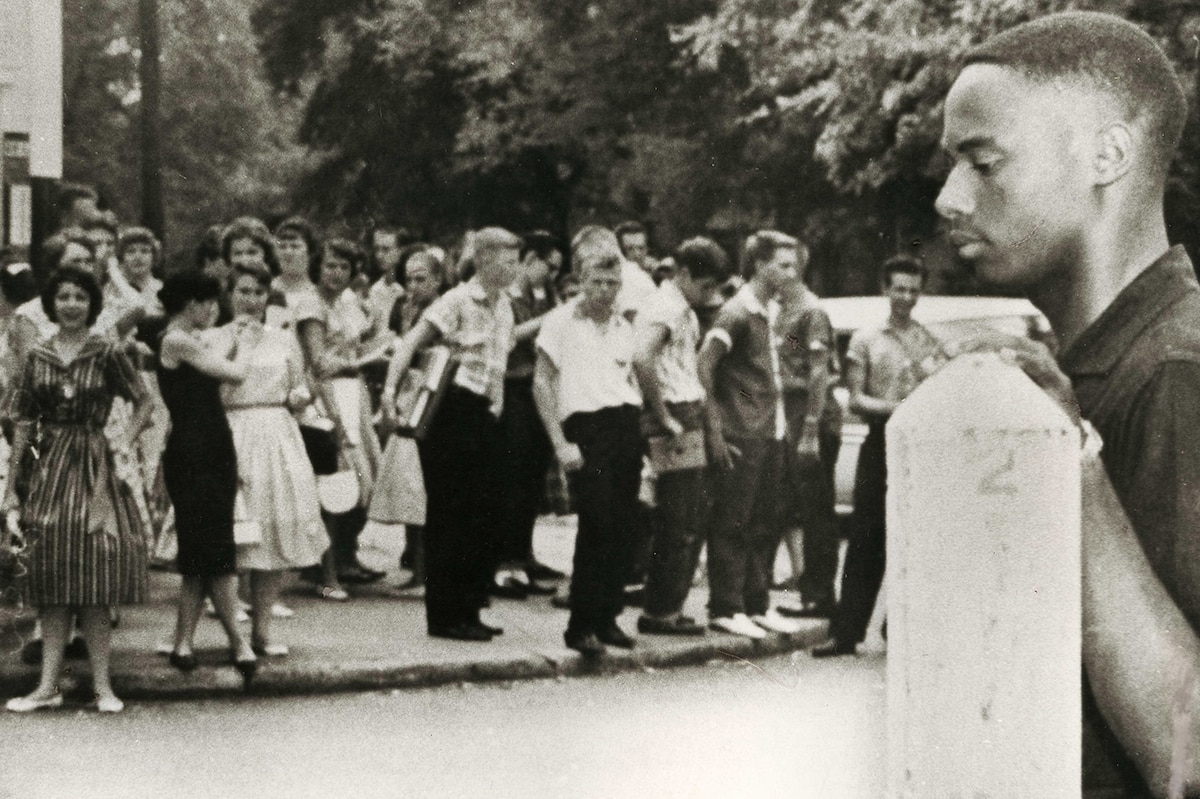
Civil rights issues are highlighted in eight daytime films airing Tuesday, May 25, the anniversary of George Floyd’s death while being restrained by a Minneapolis police officer, an event triggering Black Lives Matter protests around the nation. From a pioneering silent made by African American director Oscar Micheaux to documentaries on different aspects of the fight against racism to a sensitive depiction of an interracial marriage, the showcase explores the variety of ways in which the battle for human rights and dignity have influenced filmmakers.
The Symbol of the Unconquered (1920) is the fourth feature from African American producer-writer-director Oscar Micheaux, a pioneer in the field of “race films.” Race films were produced for Black audiences between 1915 and the 1950s, initially as a response to the racist images in D.W. Griffiths’ Birth of a Nation (1915). In The Symbol of the Unconquered, a light-skinned Black woman inherits her grandfather’s house in the Northwest and defies the Ku Klux Klan and a self-hating light-skinned Black man to set up a home there. This is one of only three of Micheaux’s 24 silents to survive. It has been restored by the Museum of Modern Art and TCM with the cooperation of the Oscar Micheaux Society.
One Potato, Two Potato (1964) stars Barbara Barrie, who won Best Actress at the Cannes Film Festival for her performance as a white woman whose marriage to a Black man (Bernie Hamilton) costs her custody of her daughter. First-time feature director Larry Peerce, the son of operatic tenor Jan Peerce, shot the film on location in Painesville and Cleveland, OH, at a time when interracial marriage was still illegal in 14 states.
Crisis (1963) documents the 1963 integration of the University of Alabama under orders from President John F. Kennedy despite Governor George Wallace’s efforts to personally block two Black students from registering for classes. The cinema-verité documentary, directed by Robert Drew, was highly controversial when it first aired on ABC’s Close-Up! series but is now considered a landmark and was added to the National Film Registry in 2011.
You Got to Move (1985) celebrates the Highlander Folk School in New Market, TN, which for almost 90 years has been fostering social change through its own programs (such as teaching Black Americans to read and write so they could pass literacy tests required to vote in some areas) and the influence of such students as Rosa Parks, Martin Luther King Jr. and Harry Belafonte. Directors Lucy Massie Phenix and Veronica Selver profile alumni working in community development, labor organization and the Civil Rights Movement.
Freedom on My Mind (1994) won the Grand Jury Prize for Best Documentary at the Sundance Film Festival and was nominated for the Best Documentary Oscar. It chronicles the push to register voters in Mississippi between 1961 and 1964, which led to the murders of the first Black man who attempted to register to vote and three civil rights workers. Using blues and gospel music as a background, directors Connie Field and Marilyn Mulford combine interviews with archival footage to depict the movement that helped inspire the Voting Rights Act of 1965.
Also screening: Norman Jewison’s Best Picture Oscar winner In the Heat of the Night (1967), starring Sidney Poitier and Rod Steiger; the short film Black Panthers (1968), which features interviews and clips of a rally for the release of Huey P. Newton; and John Waters’ original Hairspray (1988), in which Divine, Ricki Lake and Ruth Brown fight to integrate a Baltimore teenage dance show.
