After months of social distancing during the pandemic, most of us look forward to the day when we can once again safely enjoy communal events. Two TCM daytime themes in May reflect upon times when we could go out without a care and enjoy such pleasures as parties and the theatre. We all look forward to when these times will return soon, but for now we look to nostalgia to help us recall what it was like to freely indulge in these activities. Enjoy!
On May 20, the day kicks off with I Miss…Parties, which looks at movies about celebrations of one type or another from decades past. Jimmy Durante finds himself at a wild Hollywood party featuring a few key MGM and Walt Disney stars in the pre-Code musical Hollywood Party (1934). Meanwhile, Jack Lemmon and Ernie Kovacs are two army soldiers looking to outwit one another in a series of mishaps that culminate in an unauthorized dance in Operation Mad Ball (1957).
You’re unlikely to find a more scintillating party than the one dramatized in the MGM pre-Code comedy-drama Dinner at Eight (1933). This version of the hit Broadway play by George S. Kaufman and Edna Ferber was adapted for the screen by Herman J. Mankiewicz and Frances Marion, produced by David O. Selznick, and directed by George Cukor.
To match this heavyweight offscreen talent, MGM brought out four of its most powerful marquee names to head the cast: Marie Dressler, John Barrymore, Jean Harlow and Wallace Beery. Adding to this party’s irresistible appeal are such other polished players as Billie Burke, Lionel Barrymore and Jean Hersholt.
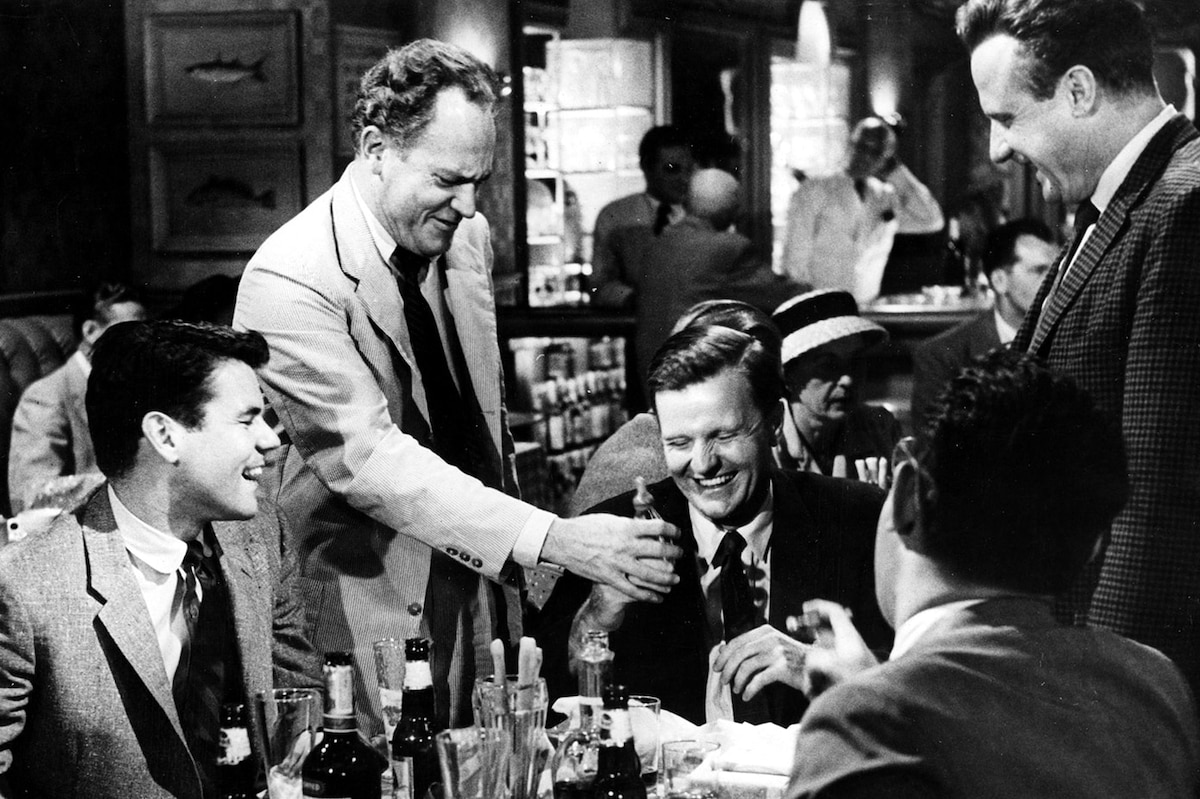
Humor is mixed with poignancy in The Bachelor Party (1957), a comedy-drama adapted by Paddy Chayefsky from his television play of the same title and directed by Delbert Mann. Don Murray stars as a married man who discovers truth about himself at a Manhattan celebration for a pal (Philip Abbott) who’s about to become a groom.
The cast includes some of the best character actors of the day, including E.G. Marshall, Larry Blyden and Jack Warden. And watch for Carolyn Jones, whose bit as a party girl is brief but so stunning that it emerged as a breakout performance that earned her an Oscar nomination as Best Supporting Actress.
“If you’ve ever been to a wilder party… you’re under arrest!” read one of the ad lines for The Party (1968), a lark of a film from comedy star Peter Sellers and writer-director Blake Edwards. Sellers plays an aspiring, disaster-prone Indian actor who is invited by mistake to a lavish Hollywood party.
Critic Roger Ebert, who once considered Sellers “the funniest comedian in the movies,” wrote of the film: “The insanity gradually escalates, but for the first two-thirds of the movie the events remain painfully close to life.”
Other party-themed films in our lineup include Father of the Bride (1950), Pajama Party (1964) and The Fireman’s Ball (1967).
I Miss…the Theatre recalls stories about the stage that have enlivened the screen and captured our imaginations over the years.
42nd Street (1933) is the ultimate in movie musicals from the Depression era, another time when audiences needed a bit of cheering up. This one dazzles with its sparkling black-and-white photography, the staging of Busby Berkeley and a cast that includes Warner Baxter, Ruby Keeler, Bebe Daniels, Dick Powell and Ginger Rogers. In addition to its musical delights, 42nd Street is full of ripe dialogue, including Baxter’s ultimatum to emergency replacement Keeler: “You’re going out a youngster, but you’ve got to come back a star!” Reportedly, the movie was so financially successful that it saved its studio, Warner Bros., from bankruptcy.
Love of the theatre is a theme that runs through Stage Struck (1958), a remake of 1933’s Morning Glory. Susan Strasberg takes on Katharine Hepburn’s former role as Eva Lovelace, an aspiring actress in search of Broadway stardom. The role did not do for Strasberg what it did for Hepburn – winning her an Oscar and leading to a lifetime of mega-stardom. Still, it’s an entertaining drama that affords Strasberg some striking moments and boasts a first-rate class, including Henry Fonda, Joan Greenwood, Herbert Marshall and, in his film debut, Christopher Plummer.
Barbra Streisand enjoys one of filmdom’s most spectacular performing debuts in Funny Girl (1968), the screen version of Streisand’s stage musical about the life and career of stage and radio star Fanny Brice. Under the direction of William Wyler, Streisand delivers a touching and often hilarious performance as Brice. She also delivers thrilling versions of more than a dozen songs, including the showstoppers “People,” “Don’t Rain on My Parade” and “My Man.” For her performance, Streisand shared a Best Actress Oscar with Katharine Hepburn (The Lion in Winter).
Our other theater-related movies include Tea for Two (1950), The Band Wagon (1953), Kiss Me Kate (1953) and The Producers (1967).
