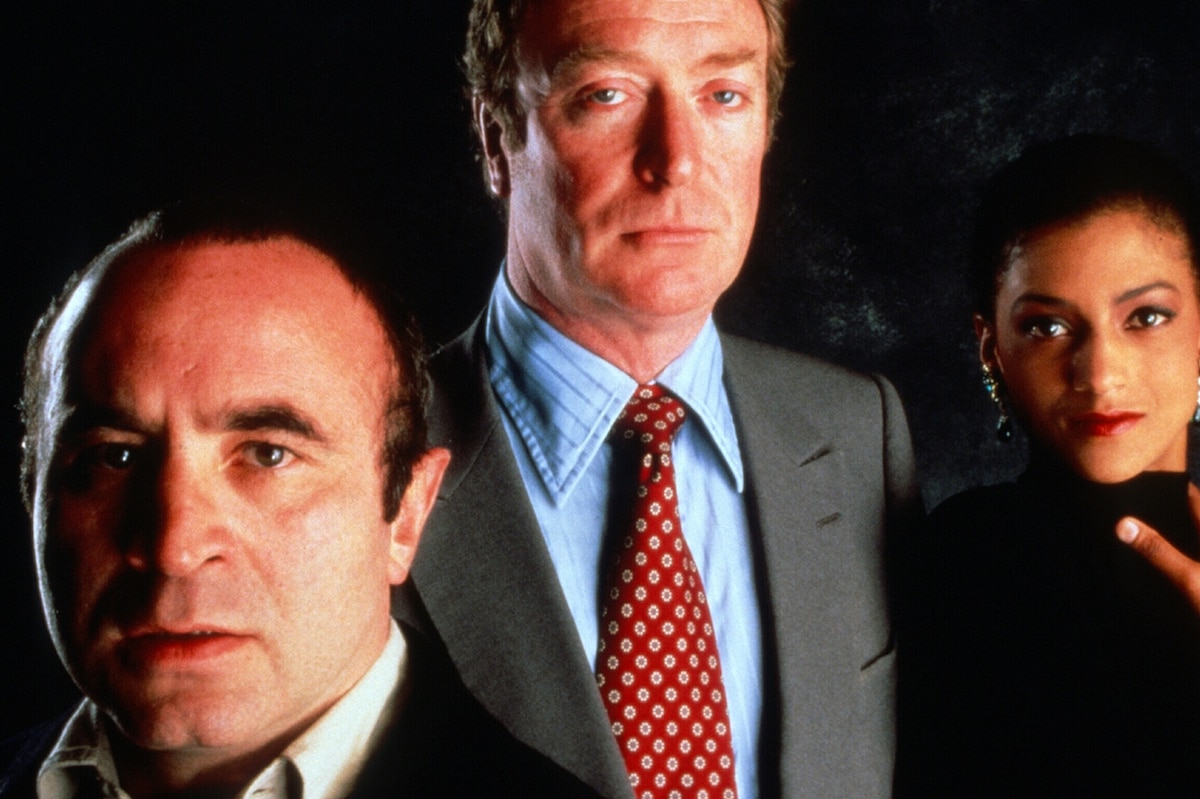
According to director Neil Jordan, Mona Lisa (1986) came to life after he’d read an article in a British tabloid about an ex-felon who had been arrested on an assault charge. In his defense, he claimed that he was protecting prostitutes from their Maltese pimps. “Steve Woolley, who had produced my previous film, The Company of Wolves (1984), felt a movie could be made from this scrap of information that would give London the dramatic presence of Paris in Le Samouraï (1967) or of New York in Taxi Driver (1976).”
At the same time, Jordan had been interested in making a film about what he called “the total and absolute gap of understanding between a man and a woman, and would have hung this obsession onto any coat hanger that became available.” In order to bring the two ideas together and onto the screen, Jordan and his producer hired David Leland to write the first screenplay.
The screenplay would undergo significant changes as Jordan met Bob Hoskins, the London actor who had risen to stardom with The Long Good Friday (1980) and the BBC hit television serial Pennies from Heaven (1978). As Jordan would later remember, “[S]uddenly I knew I had found the central character. I rewrote the whole story, with this inarticulate romantic at the center of it, brutal, pitifully simple, with a beautiful heart.” The title Mona Lisa would come from the 1950 Nat King Cole song, originally composed by Ray Evans and Jay Livingston for the Paramount Alan Ladd movie Captain Carey, U.S.A. (1950), which plays throughout the film and underscores the protagonist’s relationship with the woman he loves. “Are you warm, are you real, Mona Lisa? Or just a cold and lonely, lovely work of art?” Jordan would also use another Cole song, “When I Fall in Love” and the hit song by the pop group Genesis, “In Too Deep.”
Mona Lisa became the story of ex-convict George (Hoskins), who returns to London after spending seven years in jail. His former wife doesn’t want him around and his now-teenaged daughter (Zoe Nathenson) doesn’t know him. Desperate for a job, he goes to local mob boss Mortwell (Michael Caine), who makes him the chauffeur for a high-class black prostitute, Simone (Cathy Tyson), in charge of protecting her and driving her to her rendezvous with clients. The two begin by bickering with each other but a friendship develops. Complications arise when George falls for Simone, who asks him to help her find another prostitute, 15-year-old Cathy (Kate Hardie), who has fallen under the control of a sadistic pimp. When George learns the true nature of Simone and Cathy’s relationship, he is disillusioned and then devastated when Simone takes matters into her own hands. Also in the cast were Sammi Davis, Robbie Coltrane and Clarke Peters.
Mona Lisa was released in the United States on June 13, 1986 to mostly good notices. David Denby, in his New York Magazine review, which he titled “Love Among the Doomed,” called the film “both tender and acrid - a romantic gangster film with a hero, Bob Hoskins, who is loved by the camera. […] In movies, a stupid hero can be irritating and finally unbearable. But Hoskins […] has played men of ordinary, or less than ordinary, intelligence without losing the audience for an instant. […] Hoskins becomes not merely the hero of his movies but an actor who is loved by the camera - loved, that is, the way Humphrey Bogart and James Cagney were loved - as a possibility of honor and courage.”
The role of Simone was 20-year-old Cathy Tyson’s first film role, and it would earn her a Los Angeles Film Critics Association Award for Best Supporting Actress, a Golden Globe nomination for Best Supporting Actress - Motion Picture, and a BAFTA (British Academy of Film and Television) Award nomination for Best Actress in a Leading Role. Bob Hoskins would be nominated for an Academy Award for Best Actor, and won several awards, including the BAFTA, the Golden Globe, the Los Angeles Film Critics Association Award, the New York Film Critics Circle Award and the Cannes Film Festival Award for Best Actor. Director Jordan would win a slew of awards and nominations for both direction and screenwriting at various film festivals around the world.
When Mona Lisa was released on DVD, Neil Jordan wrote that he while he never went back to watch his own films after they were released in theaters, he did rewatch Mona Lisa. In doing so, he could see all the various themes and influences that had gone into making the film. “But most of all I could see a film of a kind there is no generic name for, but for which there should be. A film that is indistinguishable from its central performance; the moods, light, perspectives, emotions of which are defined by the central character, George, played by Bob Hoskins.”
Sources:
BFI Screenonline: Mona Lisa (1986). (n.d.). BFI Screenonline. https://www.screenonline.org.uk/film/id/480147/
Ebert, R. (n.d.). Mona Lisa movie review & film summary (1986). Movie reviews and ratings by Film Critic Roger Ebert | Roger Ebert. https://www.rogerebert.com/reviews/mona-lisa-1986
Jordan, N. (2001, March 13). Mona Lisa. The Criterion Collection. https://www.criterion.com/current/posts/112-mona-lisa
Screen: 'Mona Lisa,' starring Bob Hoskins (Published 1986). (1986, June 13). The New York Times - Breaking News, US News, World News and Videos. https://www.nytimes.com/1986/06/13/movies/screen-mona-lisa-starring-bob-hoskins.html
