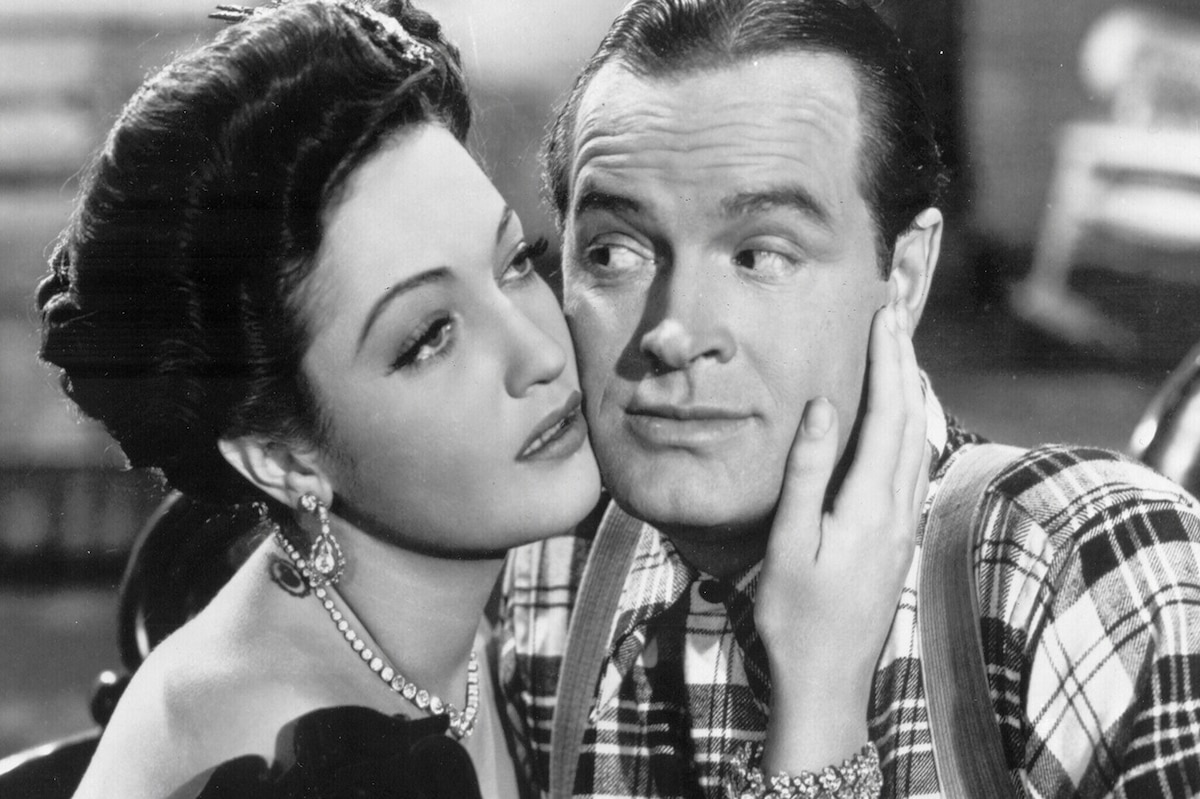
In Road to Utopia (1945), Bob Hope and Bing Crosby are on the road again. “Case those trees, that snow, that scenery and that sky,” Bing exclaims as he and Bob sled across the Yukon. Noting a familiar-looking mountain, Bob adds, “And get a load of that bread and butter.” “That’s a mountain,” Bing corrects him. “May be a mountain to you, but it’s bread and butter to me,” insists Bob, as a semi-circle of stars materializes to arc the peak and recreate the Paramount Pictures logo.
Paramount was bread and butter to a murderer’s row of actors, entertainers and comedy teams who helped establish the studio as being to comedy what MGM was to musicals, Warner Bros. to gangster pictures and Universal to horror films. On January 26, TCM is offering up a mini-Paramount-palooza with three comedies and stars that defined their eras: I’m No Angel (1933) starring Mae West; Road to Utopia with Bing Crosby and Bob Hope; and The Nutty Professor (1963) starring Jerry Lewis in his signature Jekyll and Hyde role portraying the milquetoast, accident-prone Professor Kelp and self-described “world’s greatest everything,” Buddy Love.
Paramount comedies, especially of the 1930s and ‘40s, were the smartest, the silliest and the screwiest (and that’s only the s’s). Comedy was a priority for Paramount in the silent era, and once sound came in, the studio was uniquely positioned to sign the biggest comedy stars of Broadway, vaudeville and radio for shorts and features, according to Dr. Joseph Casper, an Alma and Alfred Hitchcock Professor of American Film at the University of Southern California.
“Paramount owned most of the downtown theaters, including the Balaban and Katz chain, which was the largest circuit of first-run theaters,” he noted. “Those theaters featured movies and vaudeville entertainers. Paramount also had an interest in radio, and with its studio based in Astoria, NY, they could also see who was clicking with audiences on the Broadway stages.”
In addition to West, Hope and Crosby and Lewis, here is only a partial list of the comedy icons in Paramount’s stable: W. C. Fields, the Marx Brothers, George Burns and Gracie Allen, Jack Benny, Eddie Cantor, George Jessel, Jack Oakie and Charlie Ruggles (and his frequent costar Mary Boland).
Mae West came to Paramount with a Broadway pedigree and a 10-day jail sentence as the writer and star of the then-scandalous play, Sex. She was only a supporting character in the George Raft vehicle, Night After Night (1932), her screen debut, but she made an indelible first impression. As Mae saunters into a night club, the coat-check girl greets her with, “Goodness, what diamonds.” Without breaking her stride, West coos, “Goodness had nothing to do with it, dearie.” She stole everything but the cameras, as George Raft said afterward of his costar. Her first starring role in She Done Him Wrong (1933) established her persona as a “sexual gangster,” as modern-day burlesque queen Deeta Von Teese dubbed her in the recent documentary Dirty Blonde (2020). Its box-office success is credited with saving Paramount from bankruptcy. I’m No Angel, the follow-up, was an even bigger box-office hit.
What makes it Paramount?: In pre-Code Hollywood, Paramount did not try to tame or censor the wild, wild West of moviemaking. “When I’m good, I’m very good,” she tells co-star Cary Grant. “When I’m bad, I’m better.” As Tira, a carnival dancer and lion tamer, West is bold and independent. She needs no man to bail her out of trouble. In I’m No Angel, she takes it upon herself to conduct a courtroom cross-examination to unapologetically defend her sullied reputation. No wonder that she, along with the Marx Brothers and W.C. Fields, were rediscovered and embraced by Vietnam War-era college students for whom West, with her subversive attitudes and flouting of authority and convention, was a kindred iconoclastic spirit.
Road to Utopia was the fourth, and arguably funniest, of the seven Road to… films. For the record, I rank them: Utopia, Morocco (1942), Bali (1952), Rio (1947), Zanzibar (1941), Singapore (1940) and Hong Kong (1962). Yes, I rank Bali over Rio (I look forward to your comments). Utopia was a franchise-best at the box office.
What makes it Paramount?: It’s everything you love in a Road film, plus humorist Robert Benchley wryly kibbitzing from the sidelines. The Oscar-nominated script contains some of the series’ best character-defining gags, such as the indelible moment when Hope, trying to pass himself off as a feared killer, saunters up to a bar, orders a lemonade and then quickly course-corrects, “In a dirty glass.” Road to Utopia is undistilled silliness with meta jokes (“I thought this was going to be an A picture,” Hope scowls when Crosby enters), fourth-wall breaking (“You mean they missed my song?” Crosby exclaims when informed that some in the audience might have come late to the movie theater) and talking animals (“A fish, they let talk,” a grizzly bear complains. “Me, they won’t give one stinking line.”). The closest Road to Utopia gets to pathos is when Hope and Crosby, about to go their separate ways, seemingly let their guards down and profess their undying friendship to each other… while picking each other’s pockets.
Even Jerry Lewis doubters concede him The Nutty Professor. With his former partner, Dean Martin, Lewis enjoyed a six-year Top 10 run at the box office beginning in 1951 until their acrimonious split in 1956. Paramount signed Lewis to an unprecedented contract in 1959 that earned him a reported $10 million, plus 60 percent of the profits and the film rights, to star in 14 films over a seven-year period. Though not embraced by the critics, Lewis was boffo, especially with kids, and he was in the box office Top 10 between 1957 and 1959 and from 1961 to 1963. And with his clout, he was given the freedom to grow as a director.
What makes it Paramount?: More experimental and less flat-out funny than his previous slapstick offerings, The Nutty Professor earned Lewis uncharacteristically good reviews. It is generally considered to be his masterpiece, but that may be because people insist on interpreting Lewis’ portrayal of Buddy Love to be a caricature of his former partner. That may make this film more intriguing from a Freudian standpoint, but Lewis insisted throughout his life that he meant no such thing, and I believe him. Could be Frank Sinatra, though. Or even Lewis himself.
If you ever visit Paramount Pictures, opt for the four-hour studio tour. That gets you into the costume and prop archives, where costumes from The Nutty Professor and Road to Utopia are preserved. They are priceless relics of these first-class comedies whose absurd and anarchic spirit is undimmed, notes Randall Thropp, manager of the department. You watch these and other Paramount comedies of the period, such as the surreal Million Dollar Legs (1932) or the Marx Brothers classics, Thropp ponders, “and you have to ask yourself: ‘What were they smoking?’”
