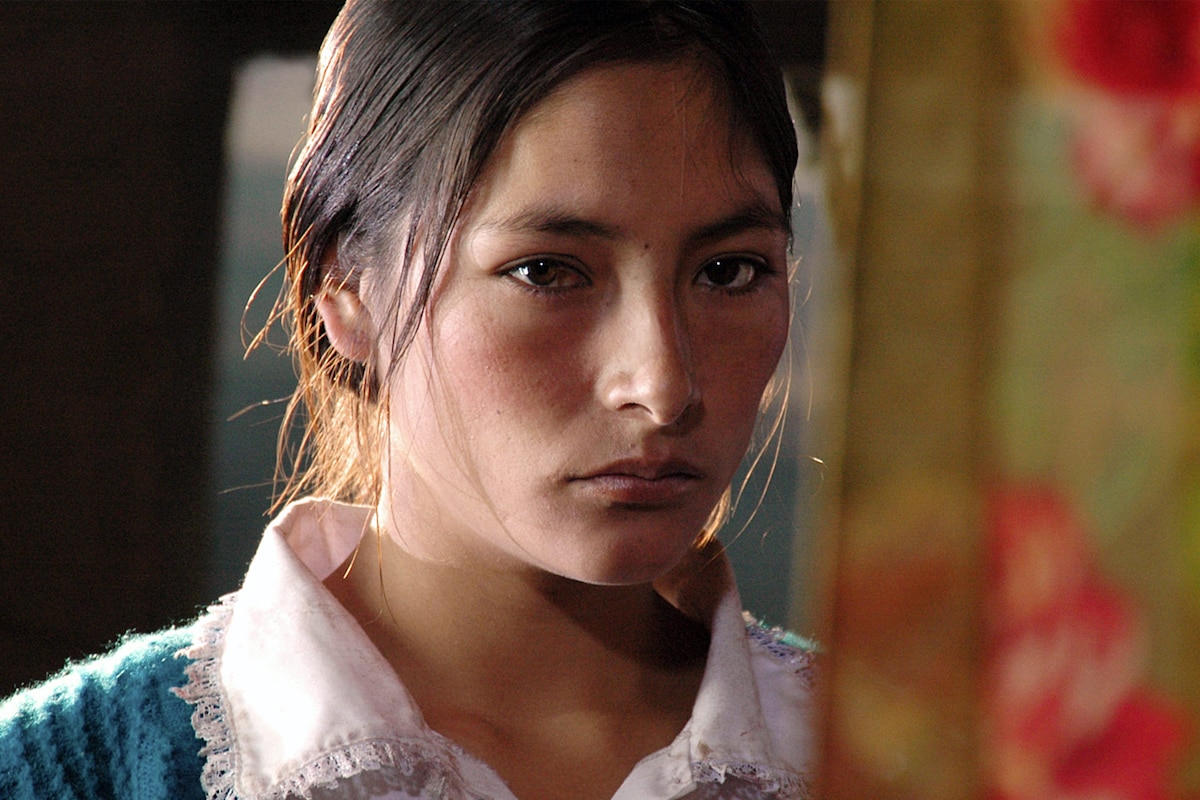
Claudia Llosa’s surreal Madeinusa (2006) tells the coming-of-age story of the titular character (Magaly Solier,) a 14-year-old indigenous Quechua girl who lives in the fictional Peruvian town of Manayaycuna. She is crowned “Miss Virgin” during “Holy Time,” a syncretic festival between Jesus’ death and resurrection. “There are no sins during Holy Time,” the townspeople say, because Jesus is not alive and not watching. And so, they have a bacchanalian carnival, drinking in excess, stealing and engaging in illicit, even incestuous sex. Madeinusa is portrayed as both a victim and a victor of this local tradition. By mixing the sacred with the profane, the extraordinary and the ordinary, the abject and the aesthetic, Llosa’s film offers commentary about the possibilities and limits of female self-determination when mores are temporarily loosened. Madeinusa is one of the most successful Peruvian films but also one of the most controversial. Critics accuse Llosa of cultural predation, perpetuating colonial stereotypes of irrational and perverted natives. The film’s inclusion of a white “criollo” stranger from Lima, the “gringo” Salvador (Carlos J. de la Torre), risks reinforcing this perspective. He inserts an outsider’s cosmopolitan gaze into the film, one that is incredulous and pitying of the townspeople. Salvador enacts his name – etymologically meaning “savior” – when he tries to rescue Madeinusa and take her away to Lima. A closer read of the film, however, reveals a biting critique of that cosmopolitan savior-complex: Madeinusa’s name is the phonetic Quechua pronunciation of the garment label “Made in U.S.A,” printed inside Salvador’s shirt; fashion magazines with European models dictate the unrealistic standard of beauty Madeinusa sets for herself; and a Coca-Cola can is nestled among a menagerie of religious effigies. Like Gabriel Garcia Marquez’s fictional town Macondo, Manayaycuna – meaning “the town no one can enter” – represents those places in the world mired in the contradictory promises of globalization. On the one hand, globalization might provide resources and opportunities; on the other, it violently disrupts local cultures. Responding to this geopolitical quandary, Llosa refuses to romanticize native primitivism and, also, refuses to offer globalization as a panacea to native disenfranchisement. Moreover, she actually cast people from the local Quechua population as the central characters of this story, committing to indigenous representation. The film was shot entirely in the village of Canrey Chico, located in the Ancash region in the Peruvian Andes. In recognition of this collaboration, Llosa premiered Madeinusa in a church courtyard in Canrey Chico, and the locals were delighted to see themselves candidly on the big screen in their own town.
by Rebecca Kumar
Madeinusa
by Rebecca Kumar | November 03, 2020
SIGN UP FOR OUR NEWSLETTERS

CONNECT WITH TCM