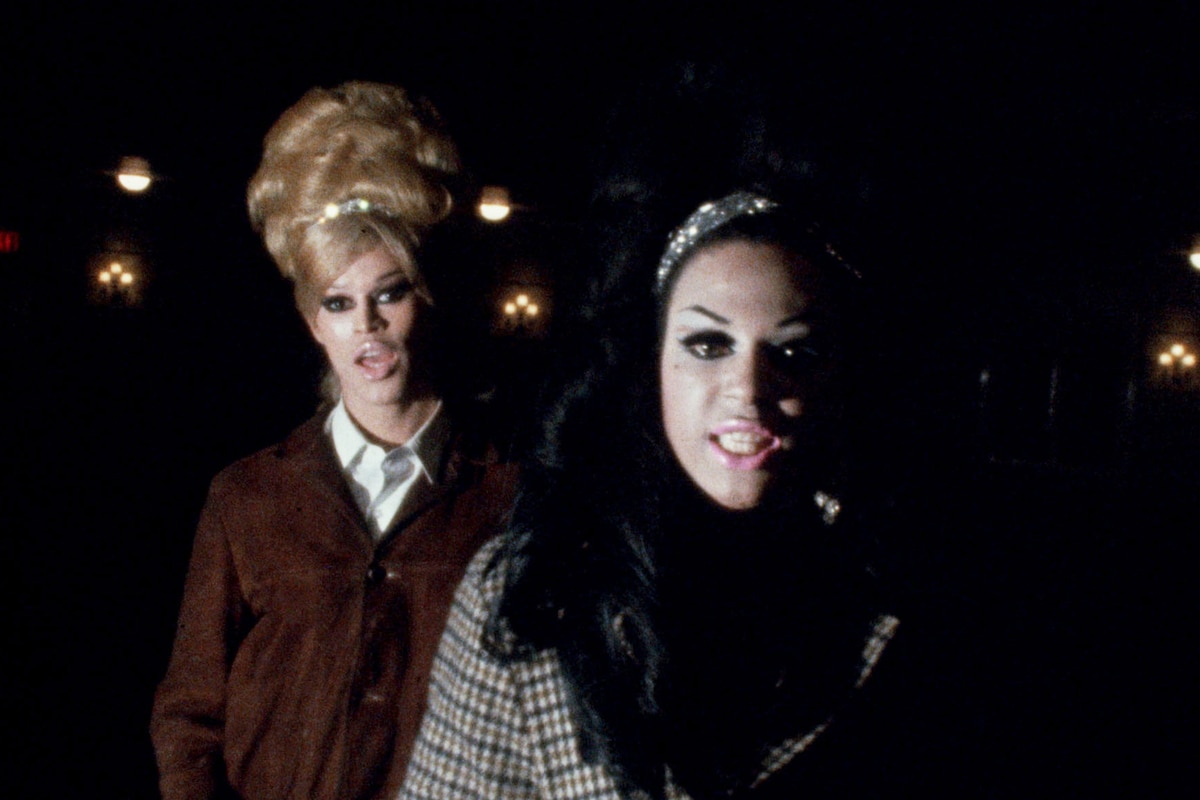
Decades before RuPaul's Drag Race and Paris Is Burning (1990), and a year before Stonewall, this 1968 documentary gave most audiences their first look at drag culture. Set against the backdrop of 1967's Miss All-America Camp Beauty Contest, The Queen was one of the first documentaries to focus on a subculture by depicting a competition. As such, it set the stage for such later hits as Pumping Iron (1977) and Stripper (1985), not to mention the classic mockumentary Best in Show (2000). Director Frank Simon's fly-on-the-wall approach, simply showing the competition participants without narration or commentary, also demonstrates the influence of cinema verité and such groundbreaking documentaries as Primary (1960), Chronicle of a Summer (1961) and The Koumiko Mystery (1965).
The Queen first introduces Jack Doroshow, the experienced drag artist who has organized the competition and hosts it under the name Flawless Sabrina. In her own words, Sabrina is "this whole bar mitzvah mother thing. You know, gaudy gowns and pushy...." The contestants arrive, rehearse for the show and bond over discussions of their love lives and families, the draft and gender-confirmation surgery. As they move toward the big event, even the most mundane of the men transform into a beautiful woman with the help of a wig, makeup, a gown and his fellow contestants. Most of the drag queens are endearing and supportive until the winner is crowned, at which point Crystal LaBeija, founder of drag's legendary House of LaBeija in 1972, goes off on Doroshow, claiming the whole thing was fixed.
The Queen is a record of the drag scene when cross-dressing off-stage was still illegal in New York. In fact, Doroshow was arrested while promoting the film in Times Square. At that time, most people thought of drag as straight men camping it up in a way that ridiculed women and gay men. Most real drag shows were held in gay bars in out-of-the-way neighborhoods in major cities like New York, San Francisco, Chicago and Atlanta that had become gay meccas. It was considered a breakthrough in 1967 that Doroshow booked a major venue, New York City's Town Hall, for his competition. He may have gotten away with it because the event was billed as "a satirical happening," with ticket sales benefiting the Muscular Dystrophy Association. That charitable association inspired first lady Claudia "Lady Bird" Johnson to serve as honorary chair for the contest, though she's nowhere on screen. Drag queens of the 1960s modeled their looks almost entirely on old Hollywood stars, with one contestant named Harlow and Andy Warhol superstar Mario Montez, named for exotic leading lady Maria Montez, providing entertainment at the show.
The picture opened in June 1968 to mixed reviews. Although praising the film, Renata Adler of The New York Times and Andrew Sarris of the Village Voice condescended to the film's subjects. Adler called them "colorful human beings whose entire life is a put-on," while Sarris said they were "eminently likable in curiously peripheral ways." The film was set to screen as part of the International Critics' Week at the 1968 Cannes Film Festival, but after the screening the festival was shut down due to the French student revolts. After a few more successful runs in Europe, the film fell out of circulation and the prints gradually degraded.
Publicity from The Queen helped Doroshow land talk show appearances as Flawless Sabrina and an acting job in Sidney Lumet's The Anderson Tapes (1971). One fan of the film, John Waters, included a poster of Doroshow in The Queen in his Pink Flamingos (1972). Most of the drag artist's time, however, was spent promoting drag culture and mentoring new generations of drag queens. In 2014, Flawless Sabrina's drag granddaughter Zackary Drucker and trans journalist Diana Tourjee organized a fund to preserve the history of Flawless Sabrina in an archive now maintained by NYU. Doroshow passed in 2017.
After decades in which the film was out of circulation, writer-filmmaker Shade Rupe (2012's Play Dead) brought the film to the attention of Kino Lorber's senior vice president Bret Wood. Under an agreement with the film's original co-producer Si Litvinoff, the distributor gave The Queen a 4k restoration using the original camera negative and reissued it in select theatres.
by Frank Miller
Sources:
Brody, Richard. "The Queen: The Documentary That Went Behind the Scenes of a Drag Pageant Years Before Paris Is Burning." The New Yorker. Posted June 26, 2019. https://www.newyorker.com/culture/the-front-row/the-queen-the-documentary-that-went-behind-the-scenes-of-a-drag-pageant-years-before-paris-is-burning
Hay, Carla. "Iconic Drag Doc The Queen Returns in All Its Glory. Newnownext. Posted June 25, 2019. http://www.newnownext.com/iconic-drag-documentary-the-queen-returns-in-all-its-glory/06/2019/
Hoberman, J. "In The Queen, Rivals Pour Their Hearts Out." New York Times. Posted June 27, 2019. https://www.nytimes.com/2019/06/27/movies/the-queen-drag-documentary-ifc.html?auth=login-facebook
Stiffler, Scott. "The Queen earns its crown in drag herstory pantheon." Low Angeles Blade. Posted February 22, 2020. https://www.losangelesblade.com/2020/02/22/the-queen-earns-its-crown-in-drag-herstory-pantheon/
The Queen (1968)
by Frank Miller | October 03, 2020
SIGN UP FOR OUR NEWSLETTERS

CONNECT WITH TCM