"My name is John Ford. I make Westerns," the filmmaker famously announced at a Directors Guild of America meeting in Hollywood in 1950. Known as a practical craftsman who got the job done with a minimum of artistic pretensions, Ford gloried in the Western as the most straightforward of genres. Yet, his Western films were filled with such powerful storytelling, visual impact and psychological insight that he is often counted among the greatest of all cinematic artists.
Every Friday of this month, TCM celebrates the legacy of Ford's vision as a versatile and uniquely talented filmmaker.
Ford did not limit his output to Westerns but worked across a wide range of movie forms with equal skill. Through the course of his career he won four Academy Awards as Best Director (a record in that category), and not one was for a Western.
His Oscars came for The Informer (1935), a drama about the Irish War of Independence; The Grapes of Wrath (1940), an account of the struggles of a migrant family during the Great Depression; How Green Was My Valley (1941), a study of a Welsh mining family during the Victorian era; and The Quiet Man (1952), a turbulent romance between an Irish-born American and fiery Irish lass in the 1920s.
All these films except the last-named (along with more than 30 others) are showing in the TCM tribute. We're also screening John Ford: The Man Who Invented America (2019), a French documentary by Jean-Christophe Klotz that explores the director's life and his impact on modern culture.
Ford (1894-1973) was born in Cape Elizabeth, Maine, and followed his older brother Francis, an actor/writer/director, to Hollywood. Ford began his own career by acting and performing stunts in his brother's silent movies and directed his first film in 1917. His first notable success as a director was The Iron Horse (1924), which established his lifelong connection to the Western.
Among the classic Ford Westerns in our tribute are Stagecoach (1939), My Darling Clementine (1946), Fort Apache (1948), 3 Godfathers (1948), She Wore a Yellow Ribbon (1949), Wagon Master (1950), The Searchers (1956), The Horse Soldiers (1959), Sergeant Rutledge (1960), Two Rode Together (1961), How the West Was Won (1962, co-directed by Henry Hathaway and George Marshall) and Cheyenne Autumn (1964).
Among the most high-profile non-Westerns in our tribute are Arrowsmith (1931), The Whole Town's Talking (1935), Mary of Scotland (1936), Drums Along the Mohawk (1939), Mogambo (1953), The Long Gray Line (1955) and Mister Roberts (1955).
Finally, from the list of films showing on TCM, here's a golden dozen of Ford pictures that may not be as well-remembered but are definitely worth viewing.
Flesh (1932) stars Wallace Beery as a German wrestler who falls in love with a beautiful gypsy (Karen Morley) with suspicious motives. For an unspecified reason, Ford had his name removed as director although an onscreen credit identifies the film as "A John Ford Production."
Judge Priest (1934) is a Will Rogers vehicle in which he plays a character created by Irvin S. Cobb. The judge, a Confederate veteran, dispenses justice in his small Kentucky town in post-Bellum Kentucky. The supporting cast includes Hattie McDaniel.
The Lost Patrol (1934) is a drama about a British patrol adrift in the Mesopotamian Desert of Western Asia during World War I. Victor McLaglen and Boris Karloff star, with Wallace Ford, Reginald Denny and Alan Hale in support.
The Long Voyage Home (1940) is a war drama based on plays by Eugene O'Neill and set on a British tramp steamer traveling from the West Indies to Baltimore, then England, in 1940. Stars are John Wayne, Thomas Mitchell and Ian Hunter. The film won six Oscar nominations including one as Best Picture.
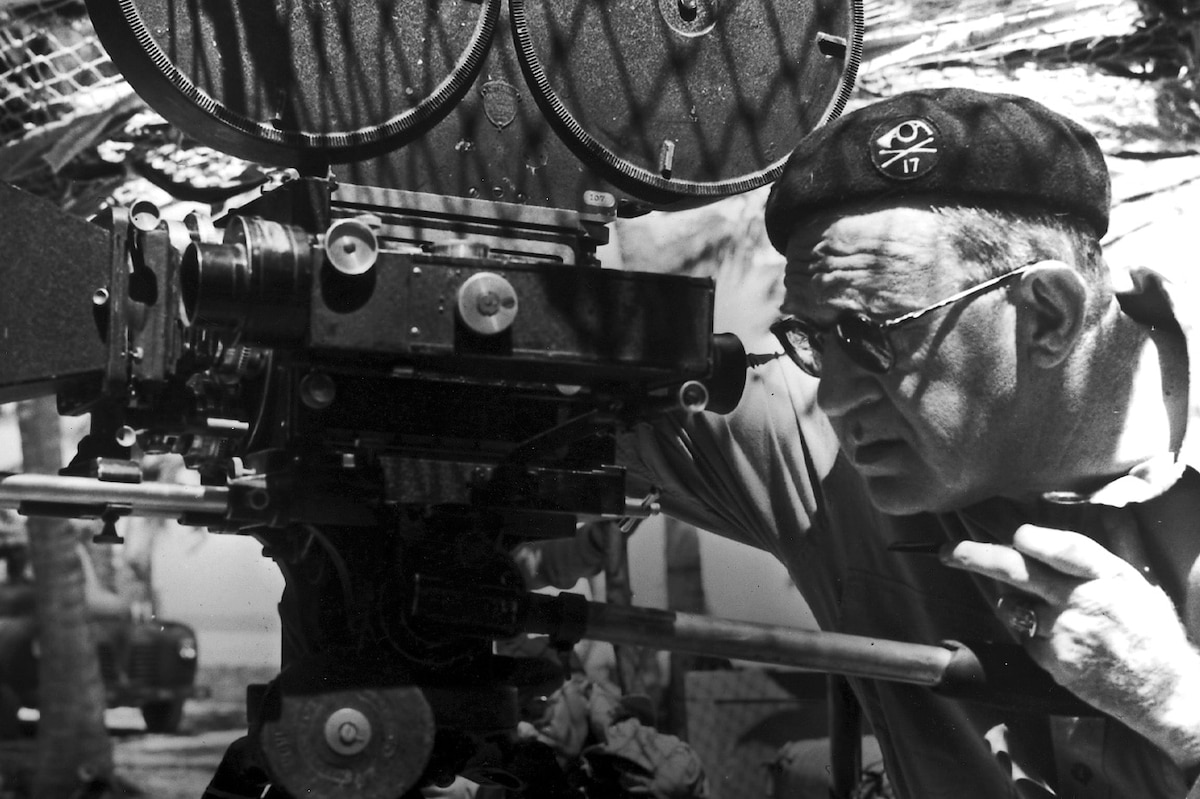
The Battle of Midway (1942) is a documentary short directed and cowritten by Lt. Cmdr. John Ford, U.S.N.R., and filmed during the Japanese attack on Midway in June 1942. The film won an Oscar as Best Short Documentary. Henry Fonda and Jane Darwell narrate.
December 7th (1943) is a docudrama short directed by Ford and Gregg Toland that looks at the bombing of Pearl Harbor on December 7, 1941 and its aftermath. Dramatized scenes feature Walter Huston, Harry Davenport and Dana Andrews. This one also won an Oscar as Best Documentary.
They Were Expendable (1945) is a war movie set in Manila in the aftermath of the surprise Japanese attack on Pearl Harbor, with a flotilla of American Patrol Torpedo boats fighting to survive an overwhelming assault by the enemy. Robert Montgomery, a real-life PT skipper during the war, plays the leader of the squadron with John Wayne as his second-in-command. Many consider this film one of Ford's best.
Rookie of the Year (1955) is a 30-minute teleplay directed by Ford for NBC-TV's Screen Directors Playhouse. John Wayne stars as a sportswriter who hopes to make a name for himself by disclosing the controversial background of a talented Yankee rookie (Pat Wayne, John's real-life son). Ward Bond and Vera Miles costar.
The Rising of the Moon (1957) is a series of three vignettes about Irish country life, based on a short story by Frank O'Connor and plays by Michael J. McHugh and Lady Augusta Gregory. Tyrone Power introduces each segment, and the cast includes Cyril Cusack, Jimmy O'Dea and Denis O'Dea. Ford shot the film in Ireland, using members of Dublin's Abbey Theatre in some roles.
The Last Hurrah (1958), based on the Edwin O'Connor novel, stars Spencer Tracy as the aging, Irish American mayor of an unnamed New England city who is facing re-election for a final time. The outstanding supporting cast includes Pat O'Brien, Donald Crisp, Basil Rathbone, John Carradine, Jeffrey Hunter and Jane Darwell.
Gideon of Scotland Yard (1958), one of Ford's smaller-scaled movies, looks at a day in the life of a Scotland Yard detective (Jack Hawkins), whose busy schedule of tracking crimes interferes with his family time. Anna Lee and Anna Massey play the inspector's wife and daughter.
Seven Women (1966), set in 1935 China, tells of a group of female missionaries who are forced to defend themselves from a ruthless Mongolian warlord and his warriors. This is the film Patricia Neal was working on when she suffered a series of massive strokes. Anne Bancroft replaced her in the leading role. Also in the cast are Margaret Leighton, Flora Robson, Sue Lyon, Mildred Dunnock, Betty Field and Eddie Albert.
by Roger Fristoe
Directed by John Ford - Fridays in July
by Roger Fristoe | August 02, 2020
SIGN UP FOR OUR NEWSLETTERS

CONNECT WITH TCM