As part of TCM's ongoing celebration "Year of the Woman," we present a series of biopics focusing on real-life female heroes who had a great impact upon the world's history and culture. From Cleopatra to Catherine the Great, the Brontë sisters to Anne Frank, Annie Oakley to Billie Holiday, we salute these remarkably accomplished women who rose above all obstacles to become prominent in their fields. Some of their stories are triumphant, some tragic - but all are inspiring in one way or another.
The movies are grouped by categories beginning with Ruling Women, which features two film portraits of Catherine the Great. The Scarlett Empress (1934) stars Marlene Dietrich as Sophia Frederica, the young woman whose name is changed to Catherine by Empress Elizabeth (Louise Dresser), and who eventually becomes Empress herself. Director Josef von Sternberg acknowledged that he was more interested in creating style than being faithful to history.
The Rise of Catherine the Great (1934) is a British film that covers similar territory, with Elisabeth Bergner in the title role and Flora Robson as Empress Elizabeth. Alex von Tunzelmann, reviewer of historical films for The Guardian, gives this one a score of "B-" for historical accuracy.
Although her performance was overshadowed by scandal and adverse publicity at the time of the movie's release, Elizabeth Taylor is quite commanding (and appropriately iconic) as Cleopatra (1963). Joseph L. Mankiewicz, in typical literate style, directed and co-wrote this grandiose version of the life of the Egyptian queen.
Other Ruling Women include Katharine Hepburn as Mary, Queen of Scots in Mary of Scotland (1936); Norma Shearer as Marie Antoinette (1938); Bette Davis as Queen Elizabeth I in The Private Lives of Elizabeth and Essex (1939); and Jean Simmons as a younger version of Elizabeth I in Young Bess (1953).
Activists and Humanitarians include Annie Sullivan, the teacher who transformed the life of young Helen Keller in The Miracle Worker (1962). Arthur Penn directed Anne Bancroft and Patty Duke to Oscars for their stunning portrayals of teacher and student, respectively. Marie: A True Story (1985) stars Sissy Spacek as Marie Ragghianti, a former head of the Board of Pardons and Paroles of Tennessee, where she confronted corruption and illegal practices. The New York Times described Spacek's performance as "radiant."
Also in this category are Greer Garson as Edna Gladley, an advocate of the rights of illegitimate children in Texas in Blossoms in the Dust (1941); and Barbara Hershey as Diana Roth, a fictionalized version of Ruth First, a campaigner against South African apartheid in A World Apart (1988).
Among our Literary Ladies are Charlotte, Emily and Anne Brontë, the 19th-century novelists and poets played by Olivia de Havilland, Ida Lupino and Nancy Coleman in Devotion (1946). Short on historical accuracy, this film is nonetheless an entertaining melodrama.
Millie Perkins has the eponymous role in The Diary of Anne Frank (1959), George Stevens' film about the Dutch-Jewish girl who gained posthumous fame for the diary that documents her life in hiding from the Nazis in an Amsterdam attic during the period 1942-44. Shelley Winters won a Best Supporting Actress Oscar for her role as Anne's neighbor in hiding, the excitable Mrs. Van Daan.
Other Literary Ladies: Jennifer Jones as Elizabeth Barrett Browning in The Barretts of Wimpole Street (1957) and Kerry Fox as New Zealand author Janet Frame in An Angel at My Table (1990).
Trailblazers include Madame Curie (1943), the Polish-French physicist of the late 1800s as played by Oscar-nominated Greer Garson. Walter Pidgeon, who also got an Oscar nod, is the husband who joins Mme. Curie in her quest to discover radium.
There's also Belgian nun Marie Louise Habets, whose story is fictionalized in The Nun's Story (1959). Oscar-nominated Audrey Hepburn stars in this film version of the Kathryn Hulme novel as Gabrielle van der Mal, or Sister Luke, whose life of service leads her to the Belgian Congo.
Other Trailblazers are Kay Francis as Florence Nightingale in The White Angel (1936), Anna Neagle as aviator Amy Johnson in Wings and the Woman (1942), Rosalind Russell as Australian nurse Elizabeth Kenny in Sister Kenny (1946), Ann Dvorak as WWII spy Claire Phillips in I Was an American Spy (1951), June Allyson as pioneering American surgeon Emily Dunning Barringer in The Girl in White (1952) and Esther Williams as Australian swimming star Annette Kellerman in Million Dollar Mermaid (1952).
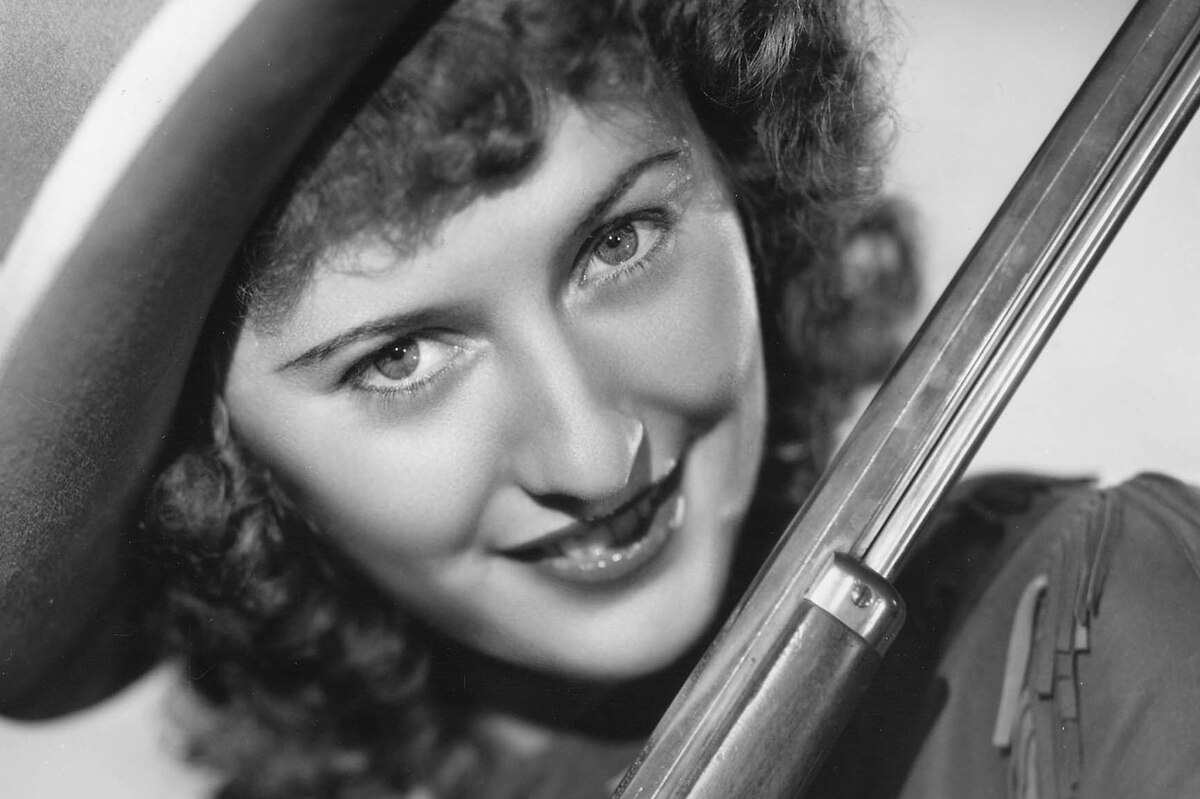
Among our other "Wonder Women" is Barbara Stanwyck as Annie Oakley, the legendary backwoods sharpshooter from Ohio who became a star attraction in Buffalo Bill's Wild West Show. The New York Times called Stanwyck's performance "splendid."
Then there's Barbra Streisand, who plays comedian/singer Fannie Brice in both Funny Girl (1968) and Funny Lady (1975). Streisand won a Best Actress Oscar for her charismatic performance in the former film, which was adapted from her hit Broadway musical of the same title and had songs by Jule Styne and Bob Merrill. The sequel picked up Brice's life at a later stage and featured a score by John Kander and Fred Ebb.
Also in the lineup is Betty Hutton as 1920s nightclub star Texas Guinan in Incendiary Blonde (1945), Katharine Hepburn as German pianist/composer Clara Wieck Schumann in Song of Love (1947), Doris Day as a musical-comedy version of Wild West heroine Calamity Jane (1953) and Kathryn Grayson as musical comedy/opera star Grace Moore in So This Is Love (1953).
Also, Oscar-nominated Susan Hayward as singer/actress Lillian Roth in I'll Cry Tomorrow (1955); Oscar-nominated Eleanor Parker as opera singer Marjorie Lawrence in Interrupted Melody (1955); Debbie Reynolds in The Singing Nun (1966) as Jeannine Deckers, a nun known as Sister Ann and credited on her recordings as Soeur Sourire; and Diana Ross as legendary jazz singer Billie Holliday in Lady Sings the Blues (1972).
