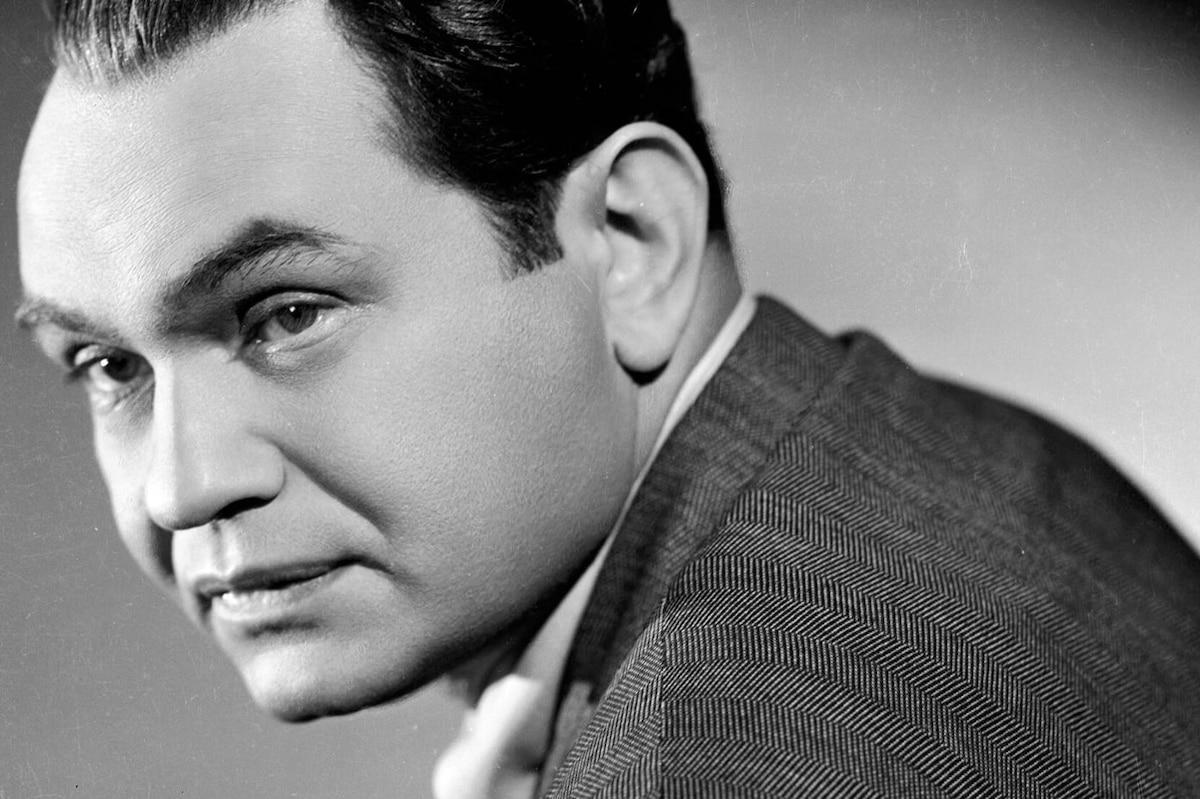
Here's to you, Mr. Robinson. Described as containing the soul of a leading man within the body of a character actor, Edward G. Robinson makes his third appearance as TCM Star of the Month, returning for the first time since 2002.
Robinson became a full-fledged star of Hollywood's Golden Age despite having what film critic Ty Burr called "the face of a catfish and a voice like a sour trombone." During his 50-year career, Robinson captivated audiences in more than 100 films at various studios, along with some dozens of Broadway plays.
The secret to Robinson's success is in the sheer weight of his talent, his actor's energy and his understanding of human nature. He specialized in arrogant, tough-talking gangsters but his range extended to crusading idealists and gentle, downtrodden everymen.
In person, Robinson appeared to be a cultured, well-mannered and congenial man. I once saw him in person at a Hollywood film premiere and, among the stars who had been lined up to promote the event, he was the only one to stroll over and mix with the crowd. I remember him greeting onlookers up close, smiling and joking and signing autographs.
In an interview late in his career, he said that "To last, you need to be real [and have] integrity as a person. And you have to work. I still work as hard, probably harder, at each role I get as I did at the beginning. To my mind, the actor has this great responsibility of playing another human being."
Robinson was born Emanuel Goldenberg to a Romanian-Jewish family in Bucharest, Romania, on December 12, 1893. Because of anti-Semitism, the family emigrated to the U.S. in 1904 and settled in the Lower East Side of Manhattan. Emanuel attended school there, eventually graduating from the City College of New York and briefly attending Columbia University.
His plans to become a criminal attorney were sidelined by his attraction to acting and a scholarship with the American Academy of Dramatic Arts. He changed his name to Edward G. Robinson, with the "G" standing for his original surname - although he kidded later that it stood for "God Knows What - or maybe Gangster?"
Robinson served in the U.S. Navy during World War I, but never saw overseas service. He began his acting career in New York's Yiddish Theater District in 1913 and within a couple of years was appearing on Broadway. His film debut came in Arms and the Woman (1916).
In the 1927 Broadway crime drama The Racket, Robinson first displayed his knack for playing a gangster. Hollywood took notice and began casting him in such roles, beginning with Paramount's The Hole in the Wall (1929), starring Claudette Colbert. He appeared in six more films before finding his breakthrough role.
Little Caesar (1931), in which he plays Caesar "Rico" Bandello, a vicious gangster obviously patterned after Al Capone, made Robinson an instant superstar at Warner Bros. The New York Times described his performance as "wonderfully effective...a figure out of Greek epic tragedy, a cold, ignorant, merciless killer...the plaything of a force that is greater than himself."
The film itself became one of the year's top moneymakers and helped launch the cycle of gangster films that would continue through the decade and beyond. Robinson himself would make 13 films between 1930 and 1932, most often playing mobsters or other powerful bosses.
Among these movies are Smart Money (1931), with Robinson as a small town barber who rises in the world of illegal gambling and James Cagney as his assistant; Five Star Final (1931), which casts Robinson as the editor of a sleazy New York tabloid; and The Hatchet Man (1932), which finds him in yellowface as a Chinese hitman.
Also Two Seconds (1932), with Robinson as a man whose past flashes in front of him in the final moments before he dies in the electric chair; Tiger Shark (1932), in which he plays a Portuguese fisherman whose young wife is attracted to another man; and Silver Dollar (1932), with Robinson as a flamboyant Colorado merchant.
Throughout the 1930s, Robinson continued giving spirited, authoritative performances in a variety of starring vehicles including The Little Giant (1933), in which he lightly spoofs his tough-guy image as a Chicago bootlegger trying to break into California society.
Robinson played double roles in both Archie Mayo's The Man with Two Faces (1934), as an actor and a producer involved in a mystery set in the world of the theater; and John Ford's The Whole Town's Talking (1935), as a notorious killer and the mild-mannered clerk who is mistaken for him.
In Bullets or Ballots (1936) Robinson plays a crusading cop who pretends to be thrown off the police force to get the goods on gangster Humphrey Bogart. This was the first of five feature films Robinson and Bogart made together. The next was Michael Curtiz's Kid Galahad (1937), playing opposing boxing managers, with Wayne Morris and Bette Davis also in the cast.
The comedy A Slight Case of Murder (1938) has Robinson as an ex-bootlegger trying to go straight. Anatole Litvak's comedy-drama The Amazing Dr. Clitterhouse (1938) casts him as a society doctor whose investigation into the criminal mind leads him to commit crimes. Bogart, Claire Trevor and members of the Warner Bros. stock company add to the fun.
In Litvak's Confessions of a Nazi Spy (1939), released during the buildup to World War II, Robinson plays an FBI agent on the trail of German/American espionage plots. In MGM's Blackmail (1939) he's a firefighter who has escaped from a chain gang only to find his past threatening him.
The 1940s, with Robinson's talent maturing and deepening, was another rewarding decade for him. Dr. Ehrlich's Magic Bullet (1940) allowed him to break free of his gangster/police typecasting by playing the Jewish-German doctor who discovers a cure for syphilis.
Brother Orchid (1940) marked a return to the gangster form, but in a stylish comedy in which Robinson's mob boss enters a monastery to find "class." Bogart and Ann Sothern costar. In The Sea Wolf (1941), director Michael Curtiz's classic screen version of the Jack London novel, Robinson is the brutal captain of a ship whose passengers include Ida Lupino and John Garfield.
In Larceny Inc. (1942) Robinson returns to comedy with a vengeance, turning in a riotous slapstick performance as a crook who wants to pull off one last heist. Billy Wilder's Double Indemnity (1944) is the ultimate film noir, with Barbara Stanwyck and Fred MacMurray as a murderous couple and Robinson as the stubborn insurance investigator on their trail.
Fritz Lang's The Woman in the Window (1944), another classic noir, casts Robinson as a psychology professor who falls under the sway of femme fatale Joan Bennett. Our Vines Have Tender Grapes (1945) is a gentle drama about a Norwegian-American family in Wisconsin, with Robinson as the father and Margaret O'Brien as his little daughter.
Scarlet Street (1945) returned Robinson not only to film noir but to working with director Fritz Lang and costars Joan Bennett and Dan Duryea from The Woman in the Window a year earlier. The Stranger (1946), also a noir, was directed by Orson Welles and concerns a Nazi hunter (Robinson) on the trail of a war criminal (Welles).
John Huston's Key Largo (1948), has Robinson returning to form as a vicious gangster threatening a group at a Florida hotel that includes Bogart, Lauren Bacall and Oscar winner Claire Trevor. This was the last of his films with Bogart, and the only one in which Bogart was billed over him.
Robinson remained busy through the 1950s, although "greylisting" by the Hollywood film industry hurt his prestige, and he often found himself working in secondary movie roles or guest-starring on television.
A champion of African-American rights and a staunch enemy of fascism and Nazism, he was accused of communist sympathies and called to testify before the House Un-American Activities Committee. Although his name was cleared, the proceedings cast a shadow over his career for a time.
Robinson's 1950s film career is represented on TCM by Illegal (1955), in which he plays a fiery district attorney who faces an emotional crisis after sending an innocent man to the electric chair. Robinson's own impressive art collection, including impressionistic works by Gauguin and Degas, was used in the film.
A highlight of the 1960s was The Cincinnati Kid (1965), with Robinson stealing this Depression-era gambling drama as the legendary poker master known as "The Man" who takes on a young challenger played by Steve McQueen. Robinson wrote in his autobiography, "That man on the screen, more than any picture I ever made, was Edward G. Robinson with great patches of Emanuel Goldenberg showing through."
Most of Robinson's acting in the 1970s was for TV, although he did make one last notable feature - Soylent Green (1973), a futuristic thriller in which he and Charlton Heston play detectives who uncover terrible government secrets in a hellish New York City.
Robinson was married to actress Gladys Lloyd from 1927 until their divorce in 1958; the couple had one son, Edward G. Robinson Jr. (1933-74), as well as a daughter from Lloyd's first marriage. In 1958 Robinson Sr. married dress designer Jane Bodenheimer.
Robinson died from bladder cancer in Los Angeles on January 26, 1973, just days after finishing work on Soylent Green. Services were held at Temple Israel in Los Angeles, with Charlton Heston delivering the eulogy. Robinson's body was entombed in a family mausoleum in Brooklyn. His image was imprinted on a U.S. postage stamp in the "Legends of Hollywood" series in 2000.
Despite his many splendid performances, Robinson was never even nominated for an Academy Award. In 1973, he was awarded an honorary Oscar as one "who achieved greatness as a player, a patron of the arts, and a dedicated citizen. In sum, a Renaissance man." He had died before the ceremony, and his widow accepted the award.
