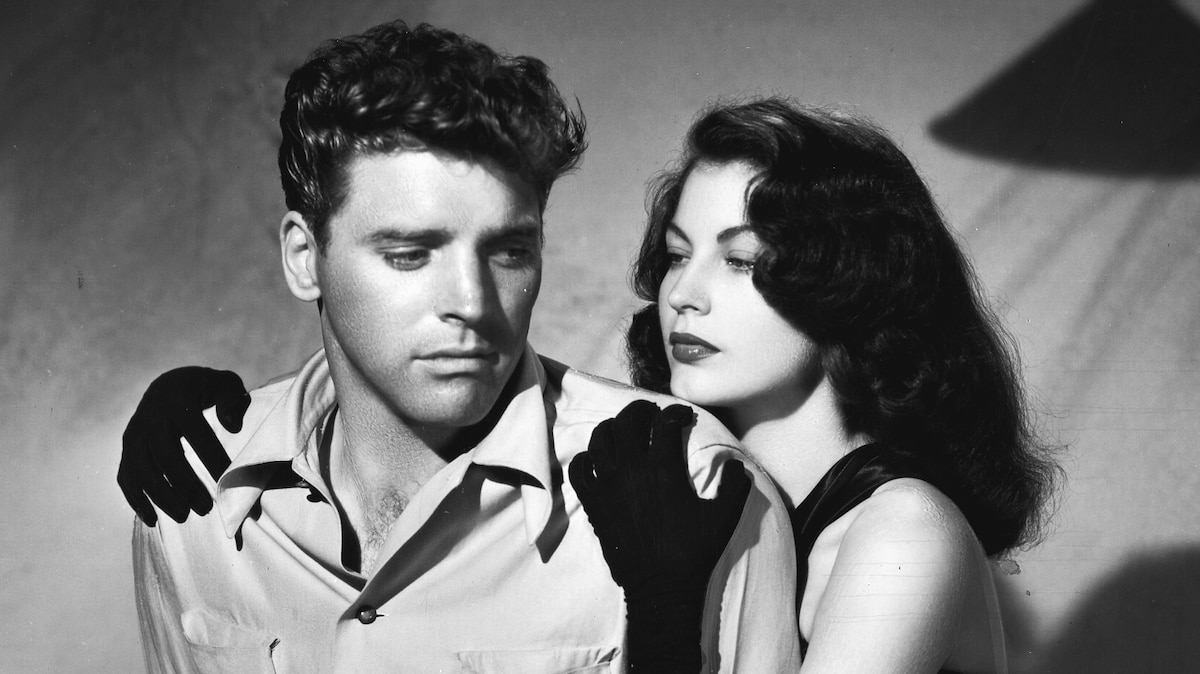
The Strange Love of Martha Ivers (1946) - April 30
Writing roughly 350 words on The Strange Love of Martha
Ivers is like talking about Citizen Kane for 120 seconds. The
subject begs for more (and I just wasted 25 words
explaining that). It's Kirk Douglas' first film and his potential
for screen power is impossible to miss. But I'm not going to
write about him. It marked Barbara Stanwyck's dynamic
return to film noir following her career-defining performance
in Double Indemnity. But I'm not going to write about her. It's
perhaps the best non-war film directed by an underappreciated
story teller, Lewis Milestone. But I'm not going
to write about him either.
I believe the best performance in the film belongs to its star, Van Heflin, as Sam Masterson, a roving gambler with abundant charm and a real-world sense of right and wrong that makes him credibly heroic. Sam drifts back into the city he fled as a boy, Iverstown, and quickly finds himself in a love triangle plus one--a love quadrilateral--with Stanwyck, Douglas and Lizabeth Scott. He gets double-crossed more than once, but rather than revenge, his outlaw's sense of justice motivates him. "I don't like to get pushed around," he tells Scott. "I don't like people I like to be pushed around. I don't like anybody to get pushed around." By this point in the picture, you're rooting for Heflin as hard as you pull for Bogie in Casablanca.
The script was adapted by Robert Rossen, who adapted the story for Milestone's brilliant World War II film A Walk in the Sun the same year. Rossen gives Heflin a steady dose of magical lines, which Heflin delivers with precisely the right mix of humor, passion, cynicism and inspiration. The best comes in a scene that mixes tough-guy brawn and romance so perfectly, it's hard to imagine watching a better blend. Boxed into a corner, Scott admits she's betrayed Heflin. "Go ahead and hit me, Sam," she cries, "I got it coming." He pauses, a long pause, before throwing his arm around her. "The only thing you got coming, kid," he says, "is a break."
I'm at 352 words, so just enjoy this movie.
by Ben Mankiewicz
I believe the best performance in the film belongs to its star, Van Heflin, as Sam Masterson, a roving gambler with abundant charm and a real-world sense of right and wrong that makes him credibly heroic. Sam drifts back into the city he fled as a boy, Iverstown, and quickly finds himself in a love triangle plus one--a love quadrilateral--with Stanwyck, Douglas and Lizabeth Scott. He gets double-crossed more than once, but rather than revenge, his outlaw's sense of justice motivates him. "I don't like to get pushed around," he tells Scott. "I don't like people I like to be pushed around. I don't like anybody to get pushed around." By this point in the picture, you're rooting for Heflin as hard as you pull for Bogie in Casablanca.
The script was adapted by Robert Rossen, who adapted the story for Milestone's brilliant World War II film A Walk in the Sun the same year. Rossen gives Heflin a steady dose of magical lines, which Heflin delivers with precisely the right mix of humor, passion, cynicism and inspiration. The best comes in a scene that mixes tough-guy brawn and romance so perfectly, it's hard to imagine watching a better blend. Boxed into a corner, Scott admits she's betrayed Heflin. "Go ahead and hit me, Sam," she cries, "I got it coming." He pauses, a long pause, before throwing his arm around her. "The only thing you got coming, kid," he says, "is a break."
I'm at 352 words, so just enjoy this movie.
by Ben Mankiewicz


TCM Shopping